

Advocacy and Engagement
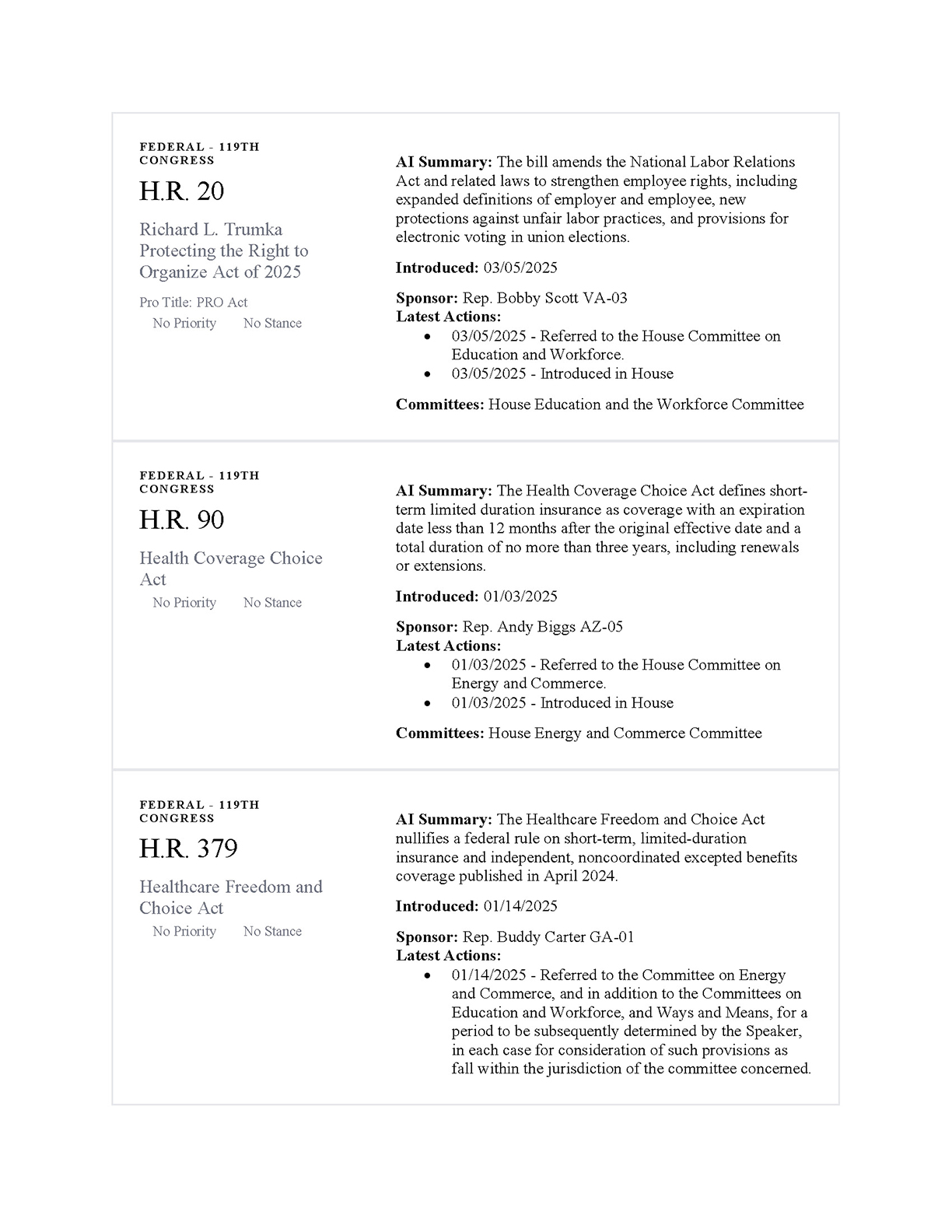
On March 10th, Lobbyit met with Keilah Ilinykh, Legislative Assistant in the office of Cliff Bentz, to discuss Rep. Max Miller’s ACCESS Act. During the meeting, Keilah asked about the differences between the ACCESS Act and the Health Care Fairness for Consumers Act (HCFCA), signaling interest in how the proposals compare on expanding coverage options and affordability. She noted that Rep. Bentz has been engaged on related efforts, including cosponsoring Rep. Buddy Carter’s legislation, and that the office would take a closer look at the ACCESS Act given its alignment with their priorities.
Keilah emphasized that healthcare affordability is a central focus for Rep. Bentz’s, noting an ongoing hearing series examining different parts of the system, including insurers and the drug supply chain, with providers likely to be the next area of review. In the coming year of the legislative session, they expect to further prioritize affordability-focused policies, and indicated that STLDI could fit within that framework. Keilah suggested there is clear alignment between the ACCESS Act’s goals and the Congressman’s broader efforts to address cost concerns in the healthcare system.
Work on the Hill
March was defined more by a short list of congressional fights than broad legislative productivity. The month was dominated by the still-unresolved Department of Homeland Security funding fight, which has extended the prolonged partial shutdown that began on February 14th, and increasingly strained airport operations, TSA staffing, and relations between House and Senate Republicans. By the end of the month, Senate efforts to advance a narrower bipartisan funding fix dissipated, House Republicans responded by passing their own short-term DHS bill, and the two chambers remained separated on both substance and legislative strategy. The public impact of the shutdown grabbed ahold of the public eye and by late March, airport security lines had become the clearest symbol of Congress’s inability to end the fight. It wasn’t until March 27th that President Trump signed an executive order demanding DHS to “find money” to fund TSA, providing relief to thousands of workers who have missed multiple paychecks. Despite the executive order, the DHS shutdown and the failure of Congress to reach a deal continued to shape the month’s agenda.
The SAVE Act fight also bled directly into the DHS shutdown. On March 23rd, President Trump told Republicans to hold up any DHS funding agreement until Democrats accepted the SAVE America Act, and though Congress is in recess heading into April, he urged Senators to keep working through Easter on the bill. That intervention added a new layer to an already brittle funding negotiation and linked two separate political fights, immigration enforcement and voting law, into a larger stalemate. Senate Majority Leader John Thune showed little interest in incorporating the SAVE Act into the funding battle, yet the White House’s demand hardened positions and further narrowed the space for a bipartisan resolution. By the end of the month, the SAVE Act had become both a core standalone bill and a bargaining chip in the shutdown dispute.
The expanding conflict with Iran has also made foreign policy a major congressional focal point. Early in the month, both chambers failed to pass efforts putting a check on the war powers of the President, continuing the Iran campaign and (for now) declining to force new congressional authorization. That debate ended up shifting from war powers to funding, as the Pentagon sought roughly $200 billion in additional money for the conflict given sustainability concerns in the munitions supply chain. Later in the month, attempts at diplomacy moved to the front when the Trump administration sent Tehran a 15-point ceasefire framework. Reports state that Iran rejected the plan in its existing form and pushed back with its own terms, including demands tied to reparations, sovereignty over the Strait of Hormuz, and a broader regional settlement.
By the end of the month, lawmakers also began looking past the shutdown toward the next budget fight. Rumors have circled regarding Republicans discussing a second budget reconciliation package, often described around the Capitol as reconciliation 2.0, as a means for new ICE funding, defense spending tied to Iran, and other pieces of the White House’s agenda before the midterms. At the same time, appropriators had already started the shift toward FY2027, with both House and Senate offices opening their portals for programmatic funding, Congressional Directed Spending, and other line item requests. In other words, Congress entered recess with one major funding fight still unresolved and the next appropriations cycle already underway.
March comprised a Congress operating under sustained pressure from overlapping domestic and international crises, with little resolution on either front. DHS remains unfunded as the two-week congressional recess began, while the SAVE Act and its integration into shutdown negotiations deepened divisions over federal authority and election law. At the same time, the expanding Iran conflict and rising oil prices pulled foreign policy and war powers back into the center of legislative debate, forcing lawmakers to confront both immediate security risks and longer-term constitutional questions. Even late-month discussions around a second reconciliations package pointed to a governing strategy focused more on procedural workarounds than bipartisan agreement. As we look towards April, Congress must still address several outstanding legislative packages while weighing federalist challenges, SCOTUS decisions on key components of the administration’s agenda, and the looming weight of the rapidly approaching midterms.
House companion to COMPETE Act Introduced
In late March Rep. Glenn Grothman introduced the House companion to Senator Ted Cruz’s COMPETE Act, legislation aimed at expanding access to more affordable health insurance options for families and small businesses. The bill focuses on restoring and broadening the availability of STLDI plans by allowing them to be offered for up to 12 months and including guaranteed renewal options. While not as comprehensive as other legislation such as Rep. Max Miller’s ACCESS ACT, these changes are intended to provide greater flexibility and lower-cost alternatives to coverage available under the Affordable Care Act.
The COMPETE Act builds on the 2018 Trump Administration’s definition of STLDI plans and introduces new provisions that would allow insurers to offer renewable plans without requiring additional underwriting. Proponents contend that these reforms will increase competition, expand consumer choice, and help reduce premiums. The bill empathizes that increased flexibility in plan design could better align coverage options with consumer needs and budgets while addressing affordability challenges in the broader healthcare market. While still early in the markup process, the introduction of the bill in both the House and Senate could yield for positive legislative momentum when the chambers return from recess in mid-April.
Energy and Commerce Committee Holds Hearings on Healthcare Affordability
A hearing this month by the House Energy and Commerce Committee’s Health Subcommittee highlighted ongoing divisions across the healthcare system, with providers, insurers, and lawmakers reiterating familiar concerns but offering few concrete solutions on affordability. Physician representatives, including leadership from the American Medical Association, pushed for higher Medicare reimbursement rates and reforms to the payment formula, while hospital groups called for greater insurer accountability and transparency in how premiums are used.
The discussion reflected broader political tensions, as Republicans defended their approach amid rising costs and recent policy changes, including Medicaid cuts and the expiration of enhanced subsidies tied to the Affordable Care Act. Democrats, meanwhile, warned that these changes could force hospitals to scale back essential but unprofitable services. Looking ahead, further action may be tied to a potential 2026 budget package, which could require additional healthcare savings and prolong debates over cost drivers and coverage.
SCOTUS Ruling Looms Over H1-B Visas
Employer groups including the U.S. Chamber of Commerce and the Association of American Universities are challenging a $100,000 fee imposed by President Donald Trump on new H-1B visas, arguing before the US Court of Appeals for the District of Columbia Circuit that the policy conflicts with congressional intent and unlawfully restricts access to the program. Their case leans in part on a recent Supreme Court of the United States decision limiting the president’s tariff authority, which they argue should similarly constrain executive power under immigration law.
The administration defended the policy by citing broad authority under the Immigration and Nationality Act, arguing the fee is intended to restrict entry rather than raise revenue. Judges on the panel questioned whether the charge functions as a tax and whether such authority rests with Congress. The outcome could significantly impact the H-1B visa program, which is widely used by technology and healthcare employers, with early signs already pointing to reduced demand following the policy’s implementation.
NY receives CMS approval for Essential Plan overhaul
New York Governor Kathy Hochul announced in early March that CMS granted final approval for New York’s overhaul of its Essential Plan, allowing the state to preserve health coverage for approximately 1.3 million residents. The approval enables New York to transition its program into a Basic Health Plan under the Affordable Care Act, following a meeting with CMS Administrator Mehmet Oz. The move is intended to maintain low-cost coverage amid broader federal healthcare changes, with enrollees set to receive notice of the transition beginning in July.
While the approval secures coverage for many, the state still faces challenges in addressing roughly 480,000 individuals who will no longer qualify under the revised eligibility threshold, which will drop from 250 percent to 200 percent of the federal poverty line. State leaders have not yet finalized a plan to cover those losing eligibility, though the issue is expected to be a key focus in ongoing budget negotiations both in New York and other states.
Dalilah’s Law Advances
On March 18, the House Committee on Transportation and Infrastructure advanced Dalilah’s Law (H.R. 5688), introduced by David Rouzer, which would establish new federal requirements for states issuing commercial driver’s licenses. The bill would require states to verify English proficiency and legal work authorization for CDL applicants, remove noncompliant drivers from service, and strengthen oversight of training programs. It also includes provisions to restrict foreign-based companies outside North America from acting as freight brokers or dispatchers, reflecting broader efforts to tighten standards in the trucking industry.
The legislation would enforce compliance by withholding a portion of federal transportation funding from key formula programs if states fail to meet the new requirements, with penalties increasing over time. While counties would not have direct administrative responsibilities under the bill, they could face indirect impacts through reduced funding if their state is found out of compliance. The measure now moves to the full House for consideration, where it may also be evaluated as part of a broader surface transportation reauthorization effort.
National Employers Association