

Engagement
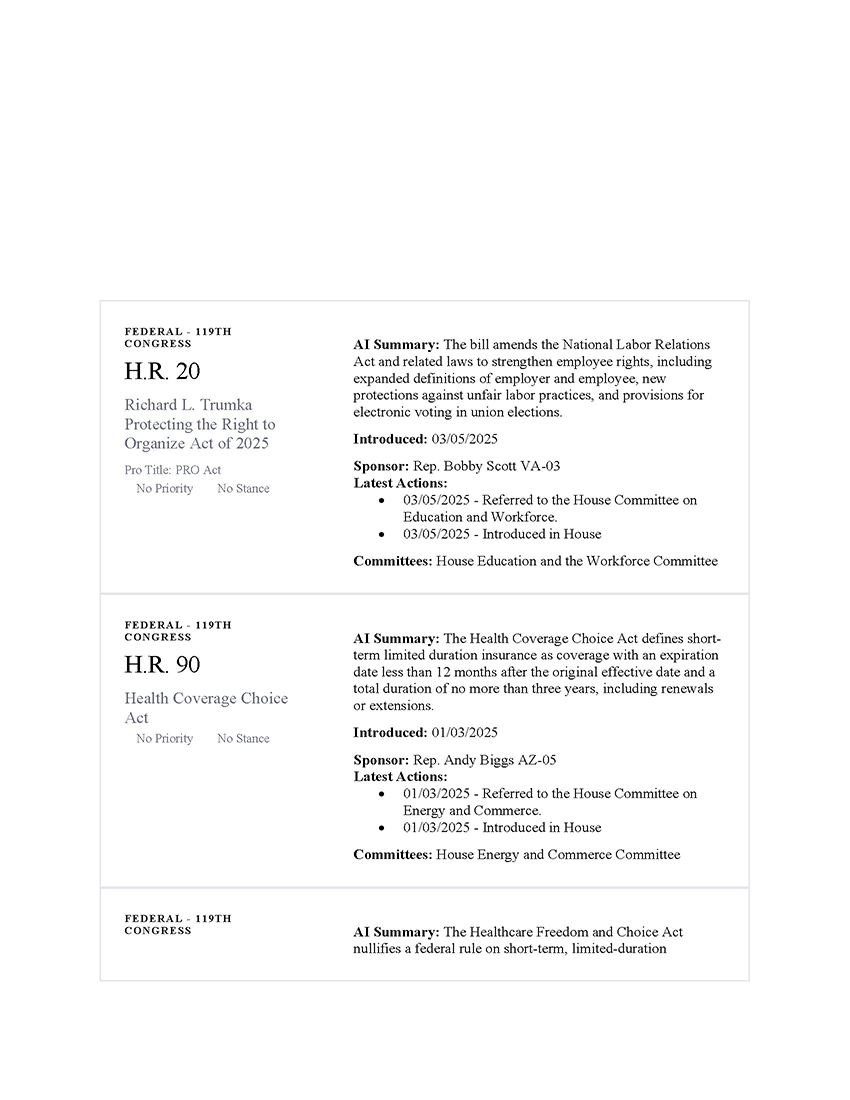
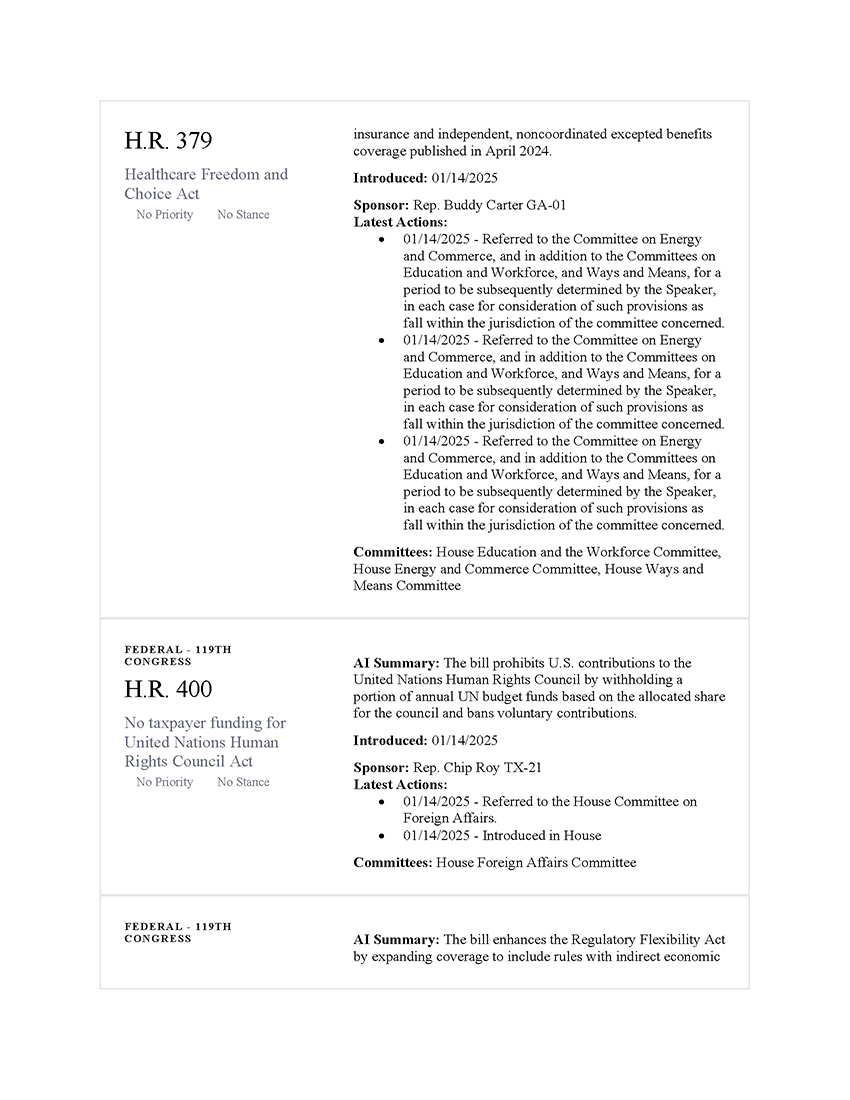
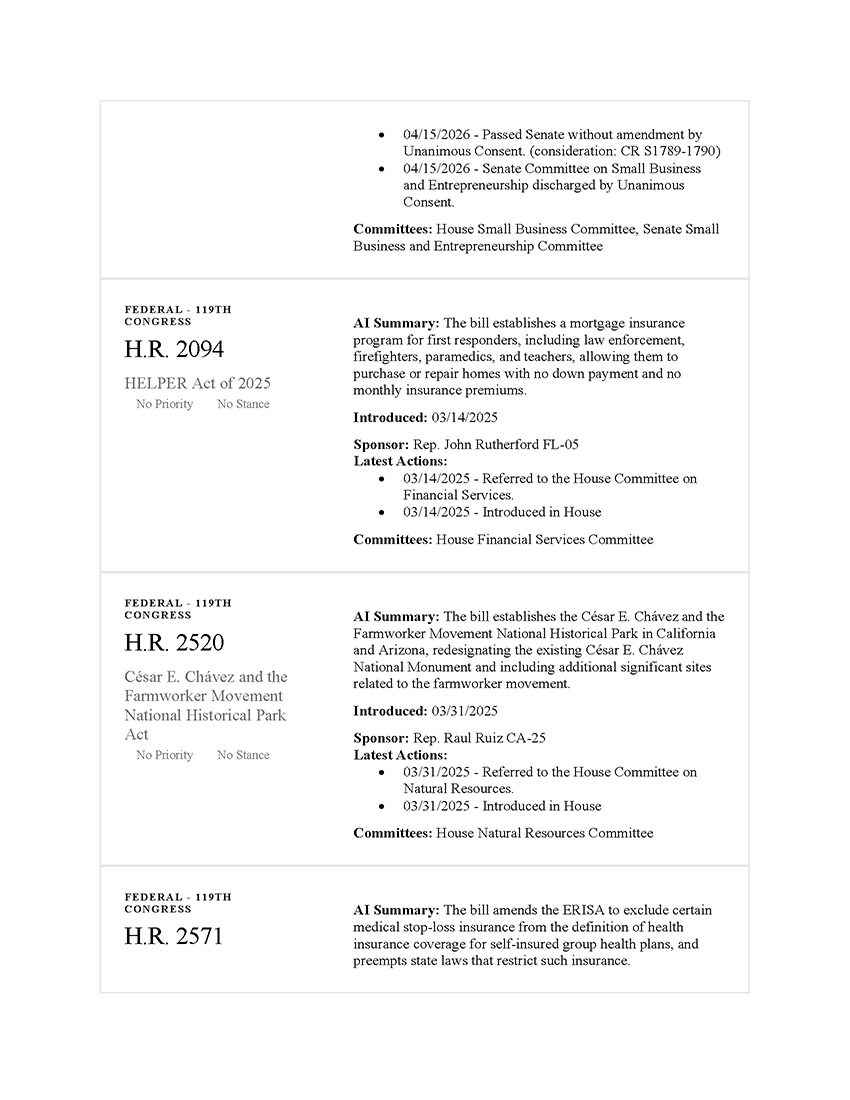
This month, Lobbyit on behalf of NEA met with Andrew Bambrick, a legislative assistant in the office of Rep. Glenn Grothman to discuss their team’s priorities, including the recently introduced COMPETE Act. We spoke about recent attempts to codify stronger language in STLDI policy and the affordable flexibility that it offers to small businesses as well as their employees. The office indicated strong receptiveness to support and NEA agreed to be formally listed on their one pager as a supporter of the bill. They also advised engaging with Energy & Commerce Committee staff and continuing outreach to help advance the legislation through markup, including building additional cosponsorship among members. The conversation also touched on the Fair Labor Standards Act (FLSA), specifically Section 14(c) and its connection to disability and employment policy. As chair of the Congressional Disability and Employment Choice Caucus, Rep. Grothman’s office expressed interest in receiving further industry perspectives on this issue. Andrew encouraged us to follow up and the Lobbyit team reached out shortly after the meeting to confirm our support for the COMPETE Act and discuss next steps.
Work on the Hill
April in Washington opened with a budget and closed with a flurry of last-minute legislating that resolved (at least temporarily) several of the federal government’s most stubborn impasses. The month’s arc ran from the White House’s fiscal ambitions to a constitutional showdown over redistricting, with nearly every branch of government generating significant news before Congress finally departed for recess on April 30th.
The administration set the legislative calendar in motion on April 3 when it released President Trump’s FY2027 budget request, a document that proposed $2.2 trillion in total spending, a 10% cut to non-defense programs, and a major buildup of the defense budget. Steep reductions were proposed across the board. The budget was dead on arrival in its current form, as presidential budgets invariably are, but it set the terms of the appropriations fight to come. The Appropriations Committees, working against a September 30th deadline, signaled their intention to begin marking up all 12 spending bills before the end of the year and kicked their work into gear. Senate Budget Committee Chairman Lindsey Graham added another avenue for the budget fight on April 21 by unveiling a budget resolution to begin a reconciliation process aimed at funding immigration enforcement agencies, a procedural maneuver Republicans need to fund ICE and CBP without running into the Senate’s 60-vote filibuster threshold.
The immigration funding question was itself urgent, because April also brought the end of the longest agency shutdown in American history. The Department of Homeland Security had been partially closed since February 14, with Democrats insisting on reforms to immigration enforcement to pass any appropriations for the department. The Senate had passed a bipartisan compromise in late March that funded most DHS agencies while leaving ICE and CBP out, but Speaker Johnson sat on the bill for over a month. It was only when emergency operating funds were days from running out — with thousands of TSA, FEMA, and Coast Guard workers facing missed paychecks — that Johnson finally brought the Senate bill to the floor on April 30, passing it by voice vote. Trump signed it the same afternoon, ending the 75-day shutdown.
The same crowded final week of April produced a Farm Bill and a surveillance standoff. The House passed the Farm, Food, and National Security Act of 2026 on April 30 by a 224–200 vote after an overnight floor session, ending years of congressional failure to replace the 2018 farm bill. The legislation reauthorizes USDA programs through FY2031, covering commodity support, crop insurance, conservation, nutrition assistance, and rural development, and drew more bipartisan support than any House farm bill in recent memory. The bill’s path to the floor had required Speaker Johnson to negotiate a separate commitment to a standalone vote on year-round E15 ethanol sales in May, illustrating the delicate coalition management that has defined the Republicans’ two-seat majority. The bill heads next to a Senate where the politics are considerably more complicated.
The month’s most operatically challenging fight, however, was over the reauthorization of Section 702 of the Foreign Intelligence Surveillance Act, the government’s authority to conduct warrantless surveillance of foreign targets. The program’s original April 20 deadline had already required a short extension. When the extended deadline arrived at the end of the month, Congress still had not resolved the central dispute: whether federal agents should need a judicial warrant before accessing Americans’ data swept up in foreign surveillance operations. Privacy-minded members of both parties demanded one; intelligence officials warned it would cripple the program. House Republican leaders threaded a partial compromise — adding oversight provisions and criminal penalties for abuse without a full warrant requirement — and tacked on a ban on a central bank digital currency to win over conservative holdouts. The House passed that three-year reauthorization 235–191 on April 29, but Senate Majority Leader Thune immediately pronounced the CBDC provision dead on arrival in his chamber. The Senate instead passed a clean 45-day extension by voice vote on April 30, the House cleared it 261–111, and Trump signed both the surveillance extension and the DHS funding bill on the same afternoon.
It was on the subject of elections and the judiciary where April may leave its most lasting mark on the year. Virginia voters approved a constitutional amendment on April 21 allowing the Democratic-controlled General Assembly to implement a new congressional map mid-decade, one that analysts estimated would shift the commonwealth’s delegation from a 6–5 Democratic edge to an advantage of 10–1 — a step in response to redistricting maneuvers by Republican-controlled states that have been encouraged by the White House. The margin was roughly three percent, boosted by heavy turnout in Northern Virginia, where former federal employees displaced by the administration’s workforce reductions turned out in significant numbers. The win, however, was immediately contested. A county circuit judge ruled the amendment unconstitutional on April 22 and blocked certification of the results. The Virginia Supreme Court heard oral arguments on April 27 and upheld the block on April 28, leaving the maps in legal limbo as the court weighs whether procedural errors in the amendment’s passage should override the results.
That fight grew considerably more complicated on April 30, when SCOTUS handed down its ruling in Callais v. Landry, effectively gutting Section 2 of the Voting Rights Act by holding that drawing congressional districts on the basis of race is unconstitutional absent the narrowest of justifications. Within an hour of the decision, the Florida House approved an aggressively gerrymandered new congressional map that could cost four Democratic incumbents their seats in November. Observers noted that Southern states including Louisiana, South Carolina, and Missouri may follow, dismantling majority-minority districts that have anchored Democratic representation in those delegations for decades. The combined effect — Virginia’s maps frozen in court, Florida’s redrawn, and a wave of potential Southern remaps now legally cleared — leaves the battle for the House majority more uncertain than it has been at any point this cycle, with months of litigation still ahead before November ballots are printed.
Woven through all of it were the quieter rhythms of executive action. Trump signed an executive order on April 3 addressing collegiate athletics, issued a cluster of presidential memoranda on April 20, and signed a retirement savings order on April 30 directing the launch of a new portal to extend Thrift Savings Plan-style accounts to workers without employer-sponsored plans. The State Department also issued new consular guidance on April 28 requiring nonimmigrant visa applicants to answer asylum-style questions about past harm in their home countries, extending the administration’s immigration enforcement posture into routine visa processing.
By the time Congress left for recess, it had resolved several of the month’s crises without fully closing any of them. The DHS fight will continue through reconciliation, FISA negotiations will resume in June, and the Farm Bill awaits a Senate that has shown little appetite for quick action. The redistricting wars, meanwhile, are just beginning. In short, while April certainly carried with it legislative progress, it leaves the door open for more work when Congress returns.
SBA Cracks Down on COVID Relief Loans
The Small Business Administration (SBA) has referred approximately 562,000 pandemic-era small business loans—totaling $22.2 billion and suspected of fraud—to the Treasury Department for collection, marking a major escalation in federal efforts to recover funds from COVID-19 relief programs. The loans are tied to the Paycheck Protection Program (PPP) and Economic Injury Disaster Loans (EIDL), both of which were widely used during the pandemic but later came under scrutiny for weak oversight and vulnerability to fraudulent activity.
According to SBA leadership, these loans had already been flagged for potential fraud during the prior administration but were not forwarded for collection action. Under current law, delinquent federal loans can be referred to the Treasury’s Bureau of the Fiscal Service after 120 days of nonpayment, where tools such as the Treasury Offset Program can be used to recover funds through tax refund garnishment or other federal payment offsets. SBA Administrator Kelly Loeffler characterized the move as the agency’s “most decisive action yet,” framing it as a corrective step to address what she described as prior inaction.
The effort is being coordinated with the White House Task Force to Eliminate Fraud, a newly established initiative created by President Donald Trump and chaired by Vice President JD Vance. The task force reflects a broader administration priority to investigate and recover funds tied to pandemic relief programs. Fraud concerns are substantial: a 2023 estimate from the SBA Office of Inspector General suggested that more than $200 billion in COVID-era small business loans may have been potentially fraudulent.
Congressional Republicans are also advancing legislative efforts to complement these enforcement actions. Senate Small Business Committee Chair Joni Ernst recently introduced a package that would extend the statute of limitations for prosecuting PPP-related fraud, signaling continued focus on accountability and recovery.
DOL Revisits Joint-Employer Classification
The U.S. Department of Labor (DOL) has proposed a new rule redefining when businesses can be held liable for wage and overtime violations committed by franchisees, subcontractors, or other partner entities. The proposal, announced by Acting Labor Secretary Keith Sonderling, revisits and updates a Trump-era framework, aiming to create a clearer and more uniform national standard for “joint employer” liability under federal labor laws.
The rule would apply across several major statutes, including the Fair Labor Standards Act (FLSA), which governs minimum wage and overtime, the Family and Medical Leave Act (FMLA), and the Migrant and Seasonal Agricultural Worker Protection Act. At its core, the proposal reinstates a structured four-factor test to determine whether a business qualifies as a joint employer. These factors assess whether the business has the authority to hire or fire workers, supervises or controls work schedules, determines pay, and maintains employment records.
A key feature of the proposal is its distinction between “vertical” and “horizontal” employment relationships. The four-factor test would primarily apply to vertical arrangements, such as those involving contractors or staffing agencies. Horizontal relationships—where workers are employed by separate but commonly owned or managed entities—would be evaluated differently, reflecting prior DOL guidance that, in some cases, combines hours worked across related employers for overtime purposes.
Notably, the proposal departs from the 2020 Trump rule by allowing broader consideration of a worker’s “economic dependence,” rather than excluding it outright. This change appears designed to address a 2020 federal court ruling that struck down portions of the earlier rule under the Administrative Procedure Act, criticizing its narrow interpretation of joint employment. DOL officials indicated the new framework attempts to reconcile varying legal precedents across federal courts.
The proposal will undergo a 60-day public comment period through June 22. If finalized, it could significantly impact franchising, contracting, and staffing models by clarifying liability boundaries while still leaving room for broader interpretation than the original Trump-era rule.
House Financial Services Advances Bills Through Markup
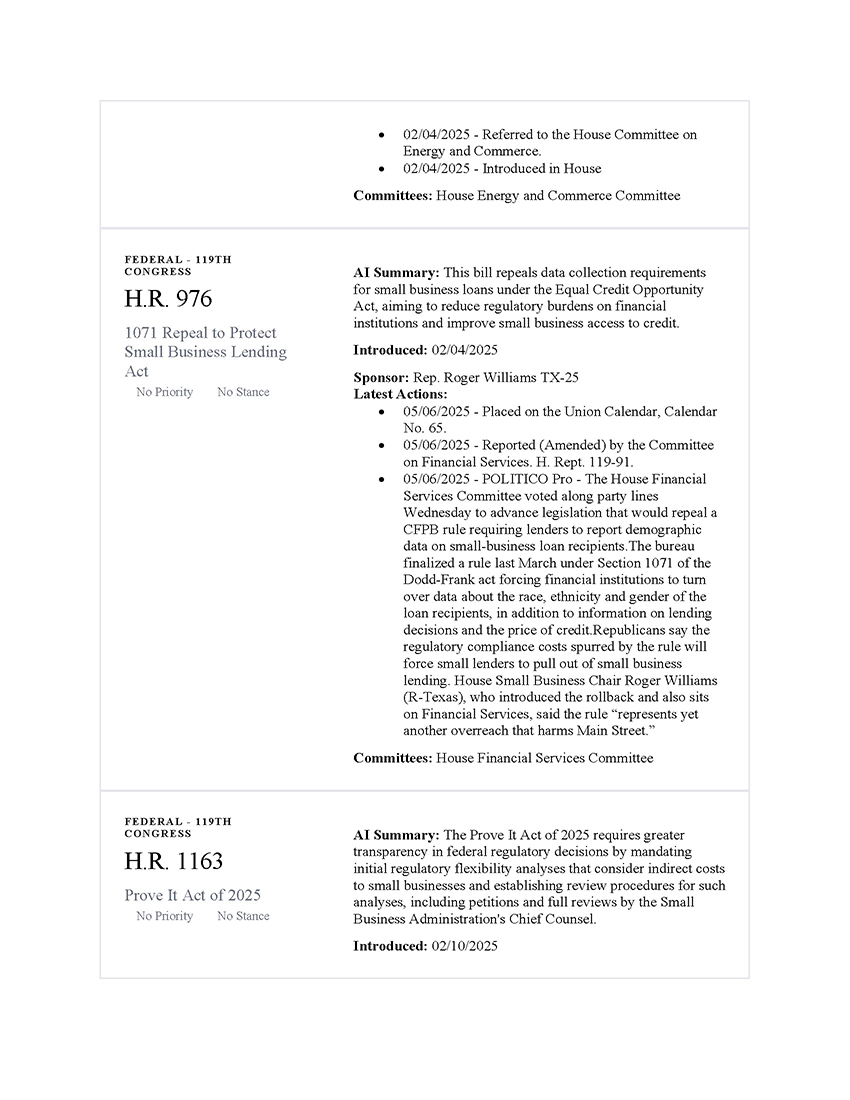
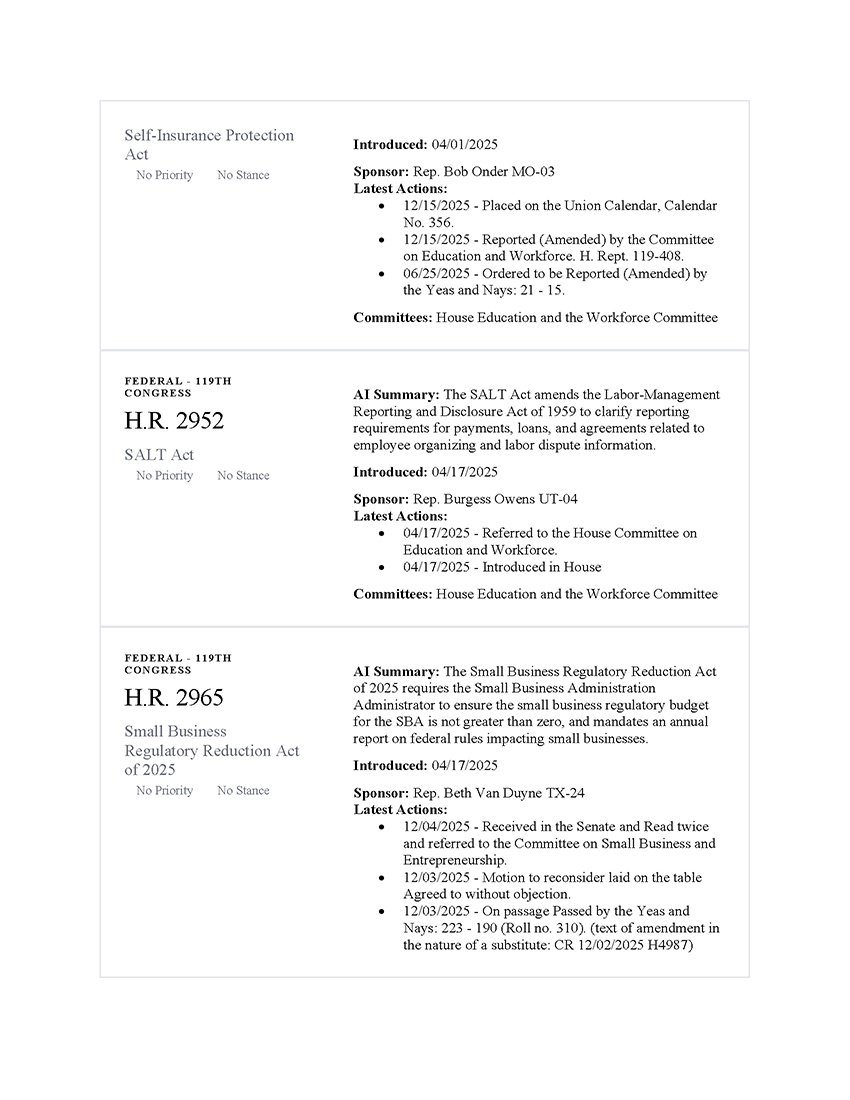
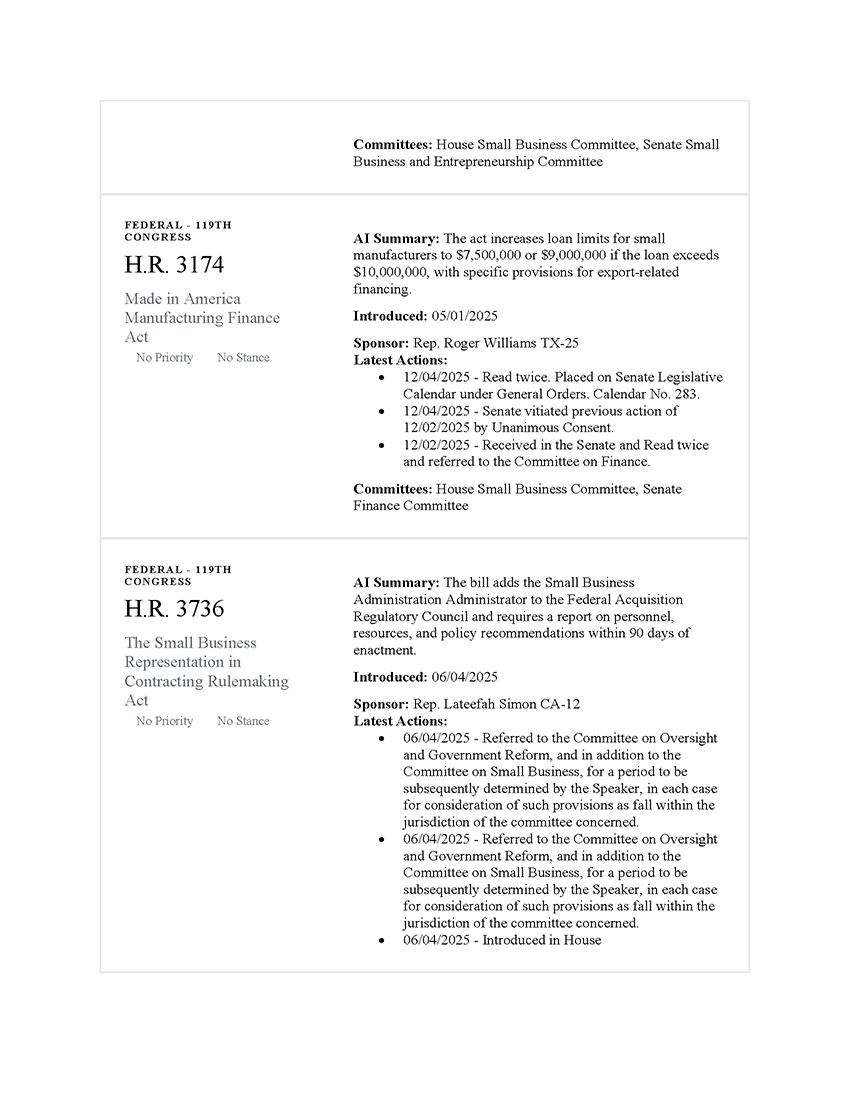
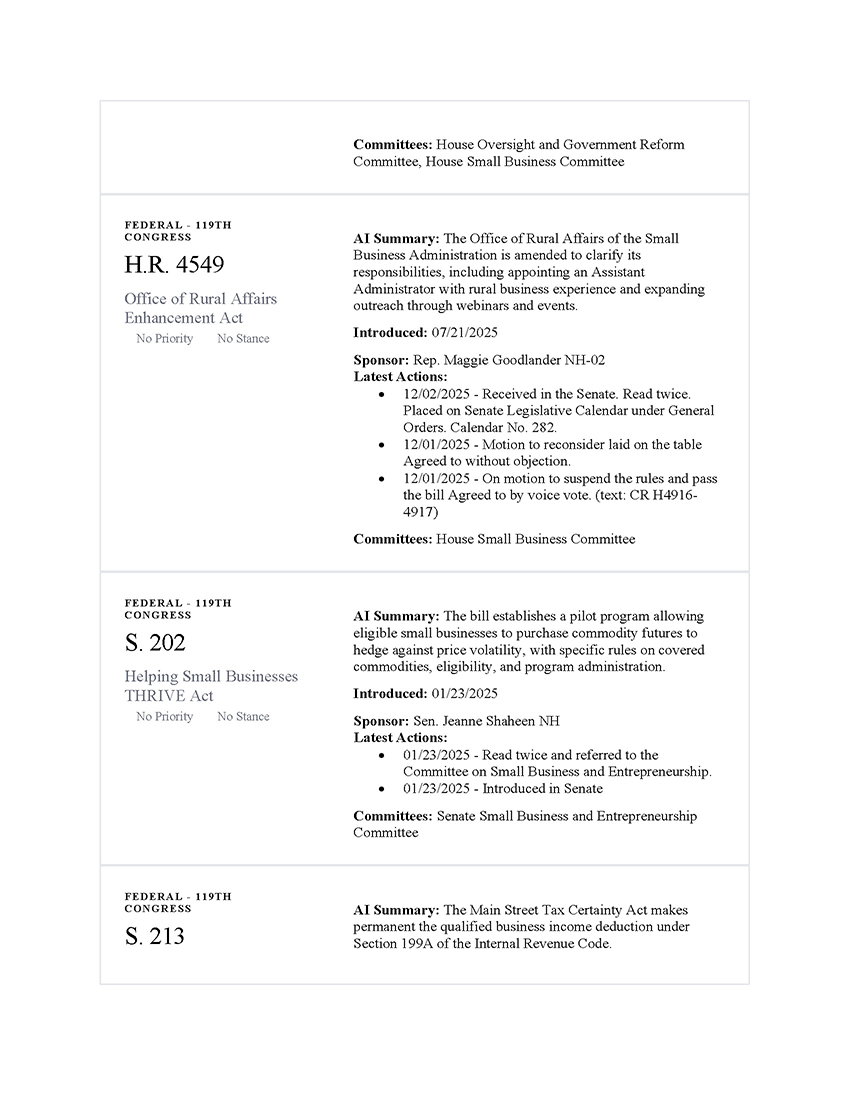
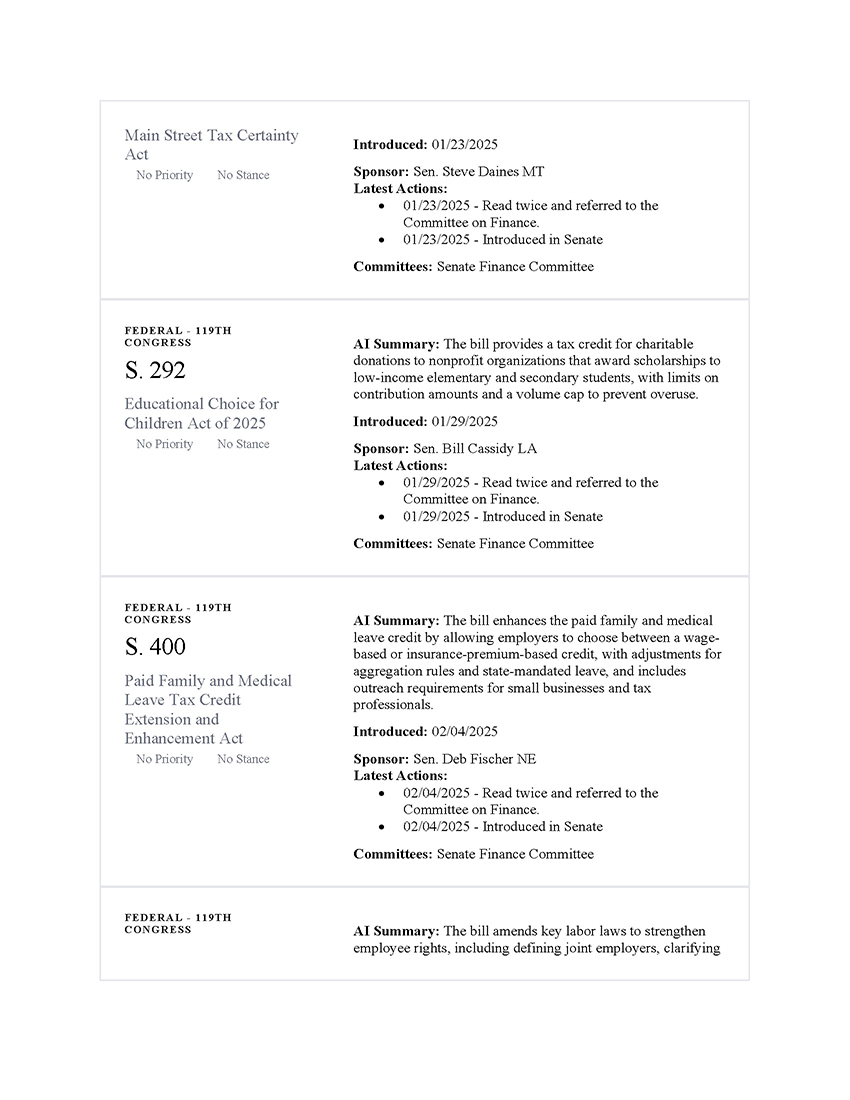
The House Financial Services Committee has advanced a package of Republican-backed financial regulatory bills, headlined by legislation to scale back a key small business lending data collection rule issued by the Consumer Financial Protection Bureau (CFPB). The primary measure, the Small Lenders Exempt from New Data and Excessive Reporting Act, introduced by Chair French Hill, passed the committee on a 26–22 party-line vote and seeks to exempt smaller financial institutions from complying with certain reporting requirements.
The bill targets implementation of Section 1071 of the Dodd-Frank Act, which mandates that lenders collect and report demographic and application data on small business credit applicants, particularly women- and minority-owned businesses. The intent of Section 1071 is to improve transparency and help regulators identify potential discrimination in lending. However, Republicans have argued that the rule imposes significant compliance costs, especially on community banks and smaller lenders, potentially discouraging them from offering credit to small businesses. Supporters of the rollback contend that easing these requirements will allow lenders to focus resources on serving customers rather than navigating complex reporting systems.
In addition to the Section 1071 rollback effort, the committee advanced three other notable bills. The Repealing Big Brother Overreach Act, which passed narrowly, would formalize an interim rule from the Financial Crimes Enforcement Network (FinCEN) to delete beneficial ownership data collected under the Corporate Transparency Act, a move critics argue could weaken anti-money laundering transparency. The Exchange Rate Accountability Act of 2026 would require the Treasury Secretary to oppose efforts to expand China’s voting power at the International Monetary Fund unless specific conditions are met, reflecting broader geopolitical and economic concerns. Lastly, the Protecting Americans’ Retirement Savings from Politics Act would impose new disclosure and conflict-of-interest requirements on proxy advisory firms, aiming to increase transparency in shareholder voting processes.
All four bills advanced largely along party lines, underscoring ongoing partisan divides over financial regulation, transparency, and the balance between oversight and regulatory burden. The legislation now awaits further consideration in the full House, where its prospects will depend on broader political dynamics and potential Senate reception.
Congress Passes Small Business Innovation Reauthorization
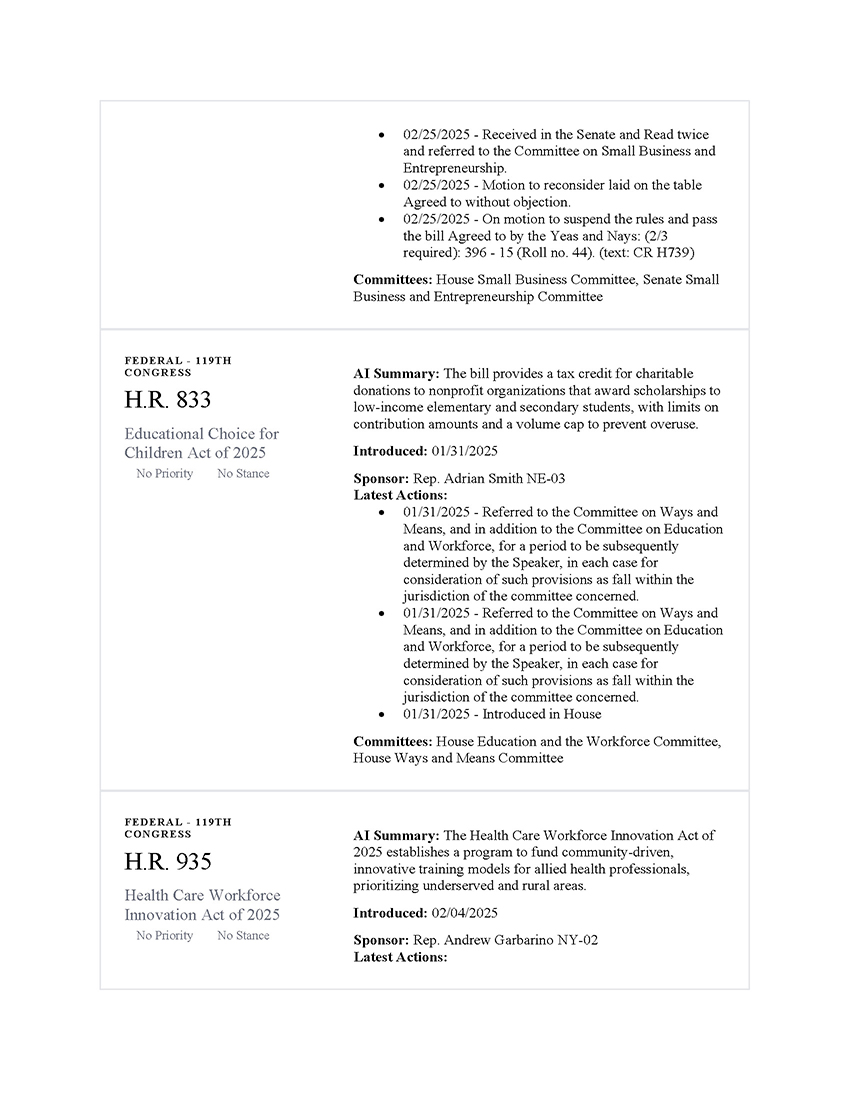
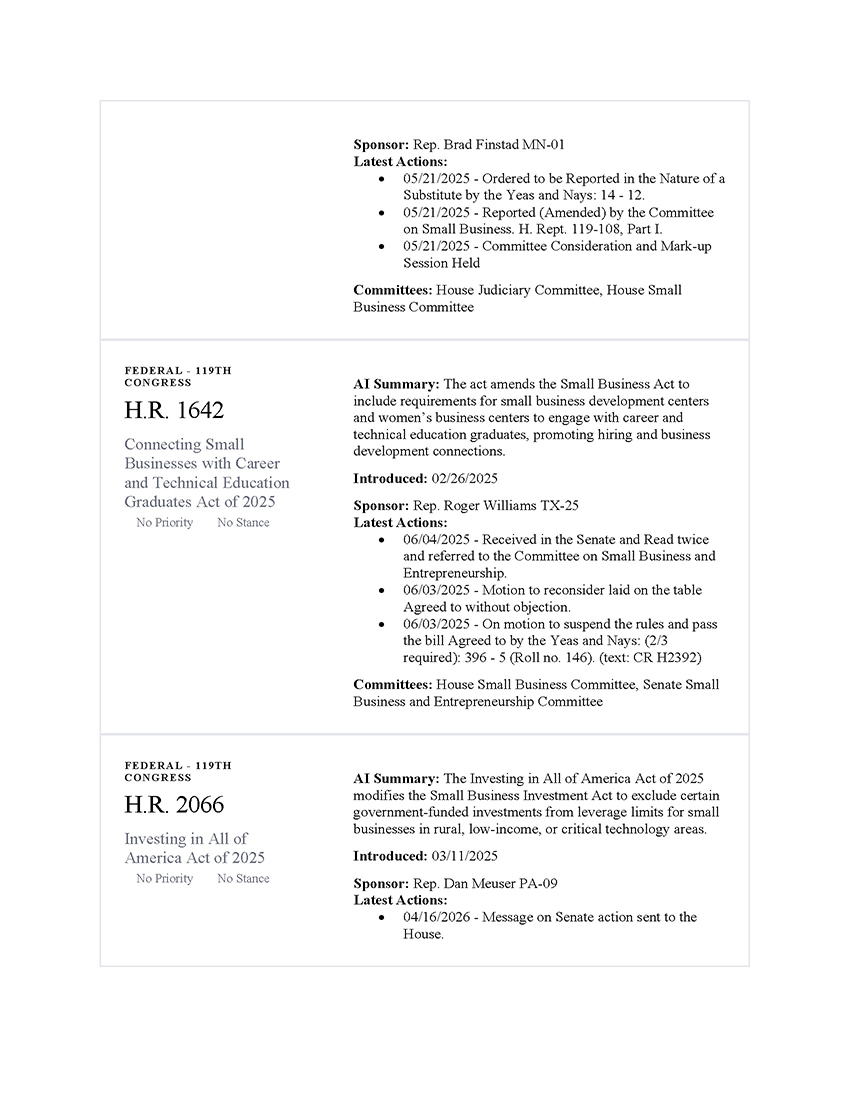
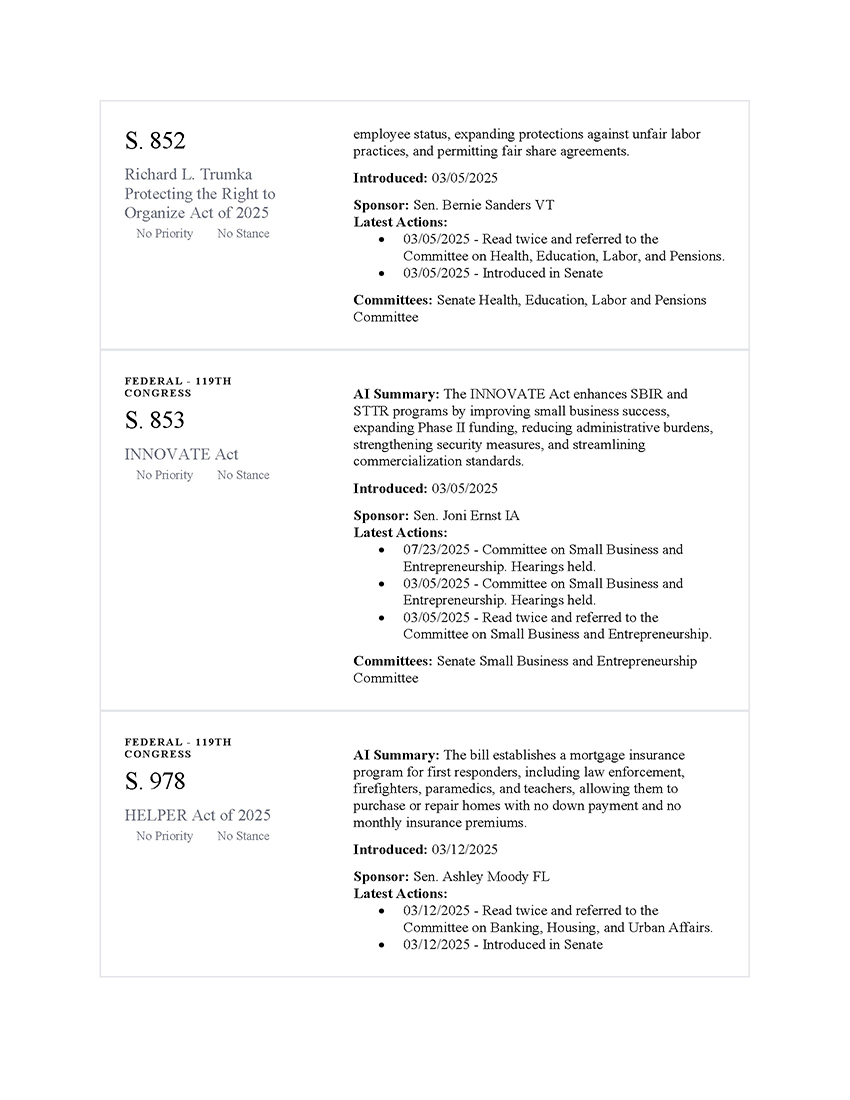
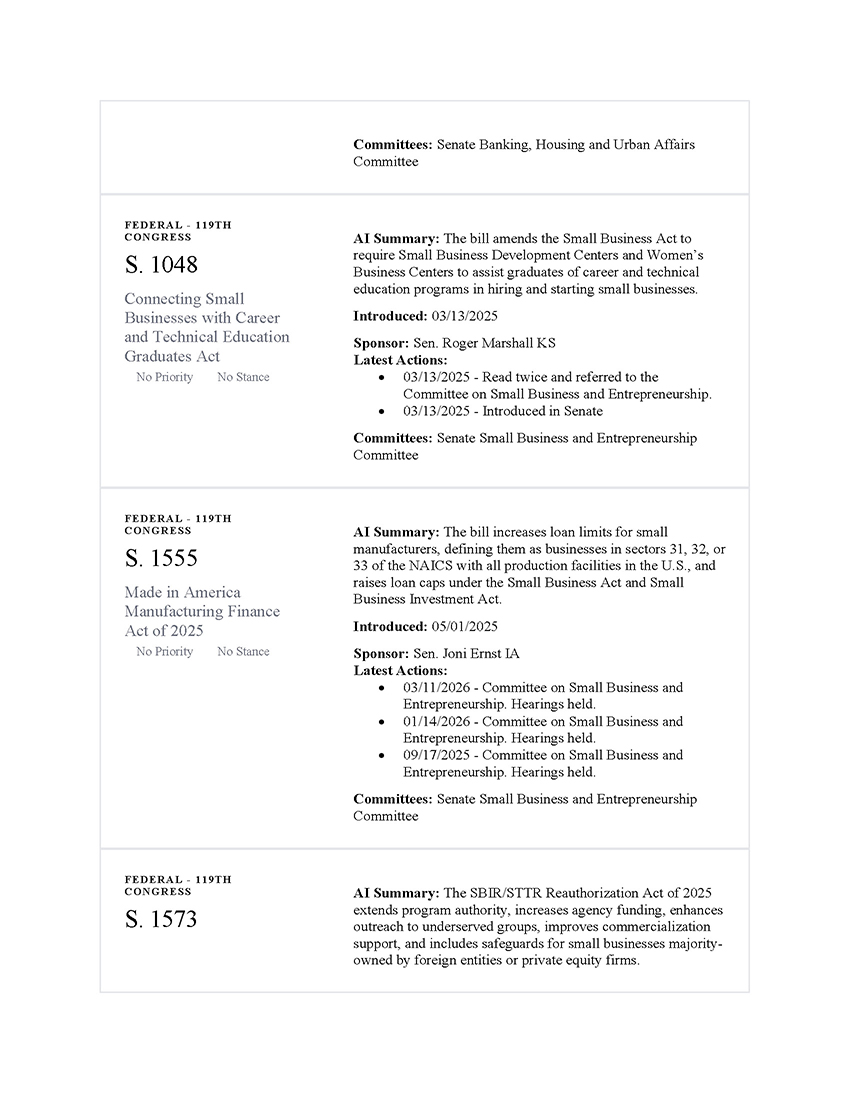
In early April, Congress passed bipartisan legislation reauthorizing two key federal small business grant programs, the Small Business Innovation Research (SBIR) and Small Business Technology Transfer (STTR) programs, after both chambers passed the measure with overwhelming support in March.
The legislation restores authorization for roughly $6 billion in federal funding that supports early-stage innovation by small businesses, particularly in technology development and commercialization. Often referred to as “America’s seed fund,” the SBIR/STTR programs had been lapsed for more than five months prior to reauthorization, creating uncertainty for participating firms and federal agencies that rely on them to spur innovation.
The reauthorization extends the programs for five years and includes a series of updated safeguards, particularly aimed at reducing foreign influence risks. These changes were a key point of negotiation in Congress, especially for Senate Small Business Committee Chair Joni Ernst (R-IA), who delayed support until stronger protections were included. The final bill introduces enhanced due diligence requirements, limits on application volumes at agency discretion, expanded lists of foreign risk entities, and new production standards tied to project status. These provisions are largely intended to address concerns about potential involvement or influence from the Chinese government in federally funded innovation programs.
The programs themselves are designed to support U.S.-based small businesses (defined as firms with fewer than 500 employees) that are American-owned and operating on a for-profit basis. Funding is intended to bridge early-stage research and commercialization gaps, helping startups and emerging companies bring new technologies to market.
National Employers Association