
Advocacy and Engagement
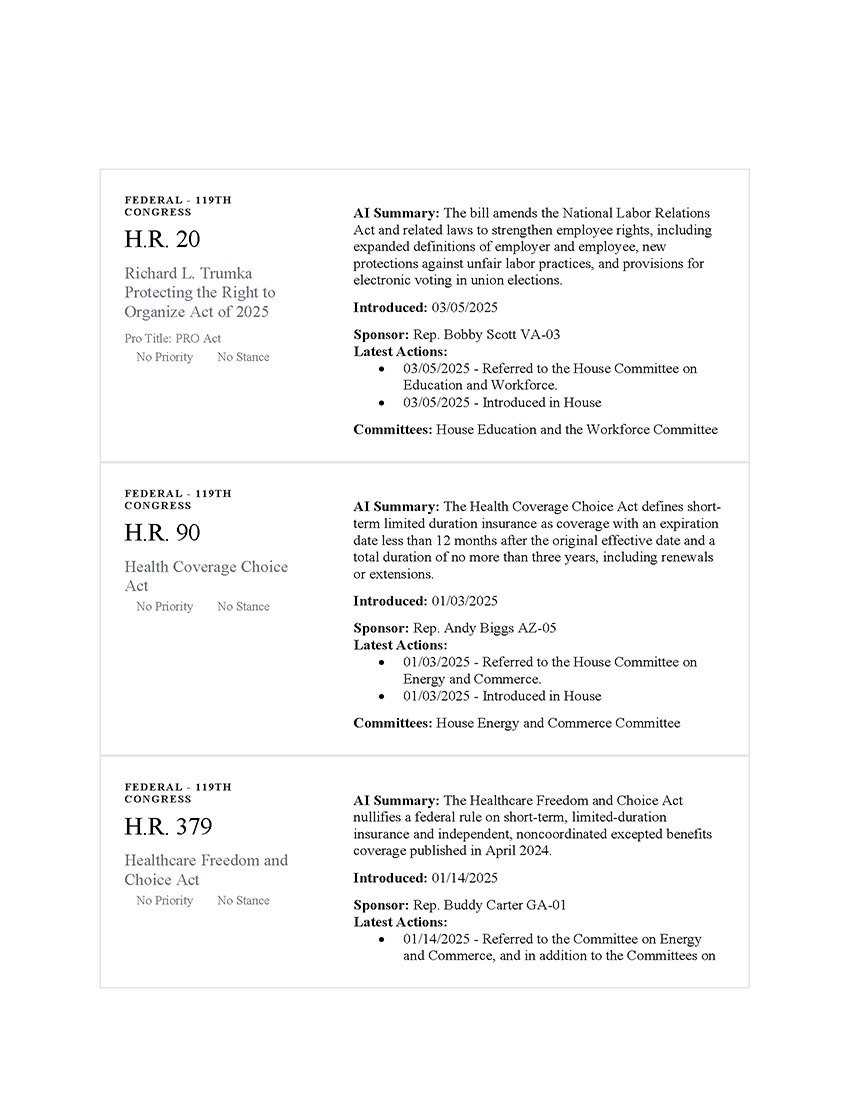
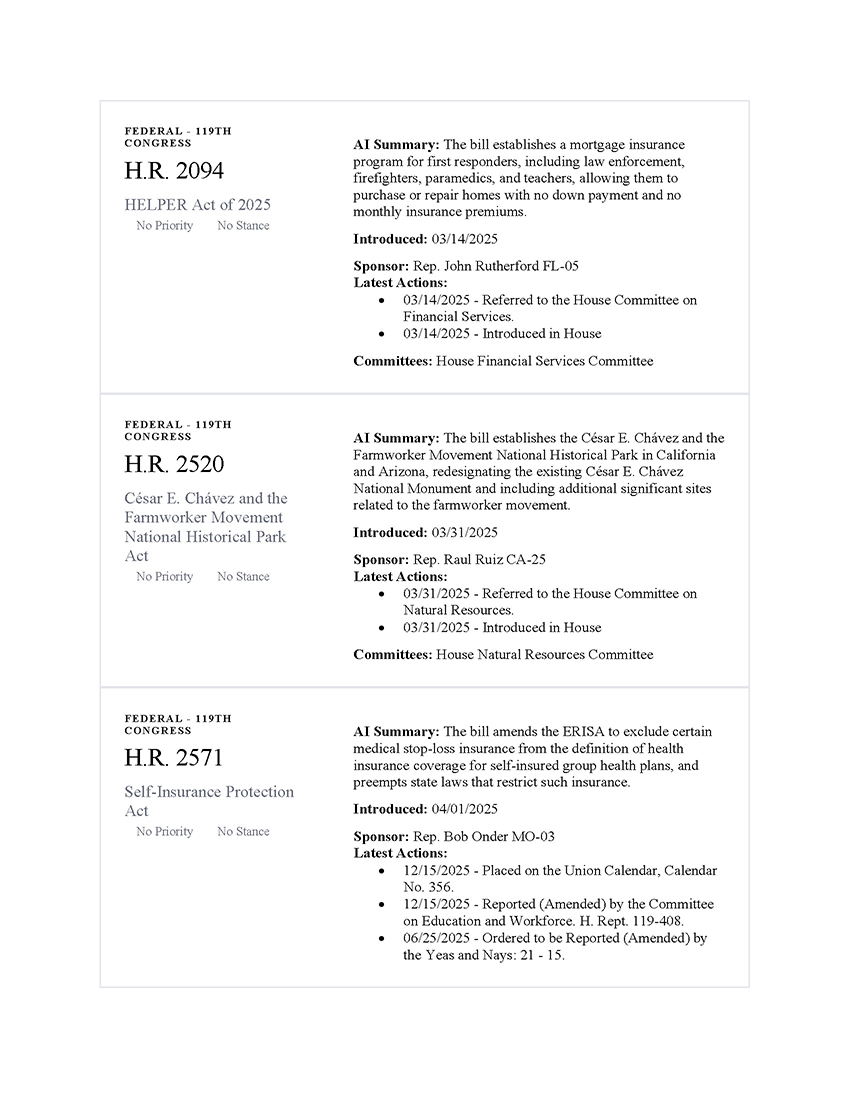
Lobbyit met on January 29th with Karen Williams, policy counsel for Rep. Max Miller, to discuss the ACCESS Act’s role in expanding access to Short-Term Limited Duration Insurance (STLDI) for up to 36 months. Karen emphasized that the office strongly appreciated NEA’s engagement and noted their office’s coordination with Rep. Buddy Carter’s team given his work on a similar bill last year that stalled out in committee. Karen explained that Rep. Miller’s motivation for introducing the ACCESS Act is rooted in concerns raised by small business owners who want to offer health coverage to employees but face significant regulatory and cost barriers under current law. They identified STLDI as one of the most viable coverage pathways for employers, particularly given rising healthcare costs and the need for more flexible insurance options. The office views STLDI as a potential “flag-bearing” alternative as Congress continues to debate how to expand or reform the ACA, noting that Rep. Miller supported extending ACA tax credits recently with the understanding that Congress must continue working across the aisle on solutions that function in practice, like STLDI.
Williams also explained that while Rep. Carter has pursued strengthening of STLDI coverage, the ACCESS Act would permanently codify the framework in statute, ensuring it is not tied to a single administration or regulatory approach. Due to Rep. Carter’s plans to run for governor, his office is not expected to move forward as a co-lead, but coordination between the offices has been productive. Looking ahead, Karen said she anticipated movement on this issue within the next six months as lawmakers search for alternatives or supplements to the ACA, identifying this period as a key advocacy window. She recommended we pursue support strategies include submitting a formal letter to the Chairs of House Ways and Means and Energy and Commerce emphasizing STLDI as a viable coverage tool, mobilizing supportive members, and engaging committee leadership to ensure the bill advances. We agreed to follow up in the coming weeks and discuss best strategies with which NEA can effectively support Rep. Miller’s work to bolster STLDI policy.
Work on the Hill
The month of January was dominated by fiscal brinkmanship and institutional strain across the federal government, culminating in a partial government shutdown at the end of the month. January reflected a broader struggle between the two parties over spending priorities, immigration policy, and the balance of power, while agencies and courts continued operating in a constrained and uncertain environment.
The most consequential development was Congress’s failure to complete all twelve FY 2026 appropriations bills before the expiration of a continuing resolution on January 31st. While lawmakers made notable progress earlier in the month, enacting roughly half of the annual appropriations measures, negotiations ultimately collapsed over unresolved disputes tied to homeland security funding; disagreements over immigration enforcement authorities, detention capacity, and policy riders attached to the Department of Homeland Security (DHS) appropriations bill proved insurmountable. Senate negotiators attempted to advance a short-term extension to provide additional time for talks, but the House was out of session and could not take up the revised measure before the funding deadline. As a result, a lapse in appropriations triggered a partial shutdown, though it is not expected to last more than a few days into February as House members are called back to DC.
The shutdown underscored the difficulty Congress continues to face in returning to standard operating pace on appropriations. While leadership in both chambers publicly emphasized the importance of completing individual spending bills rather than relying on large omnibus packages, internal divisions limited their ability to resolve high profile policy disputes within the appropriations process. The breakdown also reinforced the growing tendency to use must-pass appropriations as leverage points for broader political fights, including on education, immigration enforcement, and healthcare.
In particular, immigration enforcement served as an important backdrop to the funding standoff and Congress’ work this past month. Throughout January, the federal government expanded high visibility enforcement operations in several major metropolitan areas, drawing intense public and political scrutiny. A series of enforcement related incidents, including multiple fatal shootings of American citizens, sparked protests in multiple cities and amplified calls for oversight and reform. These developments hardened positions on the Hill, with Democrats in both chambers calling for explicit limits to ICE’s funding and enforcement capacity to be included in the appropriations negotiations. Immigration enforcement eventually became the central issue preventing a final compromise, illustrating in large part how the White House’s operational decisions reverberate through the appropriations process.
Beyond the budget fight, Congress continued to advance legislation in several domains. Congress passed several appropriations measures earlier in the month, including signing off on the budget for education, transportation, defense, labor, and other federal agencies. In both chambers, lawmakers attempted to reassert congressional authority over military engagement, but failed to pass a war powers resolution aimed at limiting unilateral military action by the administration.
Foreign policy developments also shaped the federal landscape in January. The administration remained actively engaged in international security matters, including its operation to seize and arrest Venezuelan President Nicolas Maduro, where US involvement continues to draw congressional and public attention. The month also saw the administration participate in high level international economic and security forums, emphasizing supply chain resilience, energy security, and geopolitical competition. These engagements occurred against the backdrop of President Trump’s call for Denmark to cede Greenland to the US, reinforcing the contrast between US global leadership ambitions and the international order.
Federal agencies continued their regulatory work during the month, though activity slowed as shutdown preparations intensified. Several agencies advanced rulemaking and policy initiatives earlier in January, including defense related investments in emerging technologies and artificial intelligence. However, as the funding deadline approached, agencies once again shifted focus to contingency planning, delaying some planned discretionary actions and public engagement.
The federal judiciary played a stabilizing role amid the broader uncertainty. Federal courts issued rulings blocking key elements of an executive order related to federal election administration, finding that the administration had exceeded statutory authority and intruded on powers reserved to Congress and the states. At the same time, judges continued to hear emergency motions tied to immigration enforcement, including challenges to the scope of federal agent authority and the use of expedited removal procedures in major metropolitan areas.
Overall, January illustrated the interconnected nature of fiscal policy, immigration and high-visibility policy issues, and institutional authority in Washington. A breakdown in appropriations negotiations ultimately led directly to a partial shutdown, but the roots of that failure extended beyond topline spending levels to deeper disputes over executive power and Congressional leverage. While lawmakers made incremental progress in some areas, the month ended with unresolved funding questions and a federal government operating under strain.
Vought requests CFPB funding
This month Russ Vought, Director of the Office of Management and Budget and acting Director of the Consumer Financial Protection Bureau (CFPB), formally requested funding for the agency from the Federal Reserve. This move followed a federal court directive issued late last year requiring the administration to keep the CFPB operational while ongoing litigation over the agency’s structure and funding is resolved. The CFPB’s funding mechanism, drawing directly from the Federal Reserve rather than annual congressional appropriations, has been at the center of a broader legal and political effort by the administration to curtail or dismantle the agency.
Throughout 2025, the administration pursued arguments that CFPB funding requests were unlawful while the Federal Reserve was operating at a loss, raising the possibility that the bureau would be forced to halt operations once its existing funds were depleted. That outcome appeared increasingly likely until the Federal Reserve returned to profitability in early December. Shortly thereafter, a US District Court judge clarified that the standing injunction not only prevents the administration from dismantling the CFPB but affirmatively requires Vought to seek funding to maintain its statutory functions. The judge also expressed skepticism toward the administration’s legal theory challenging the funding mechanism.
California clashes with Trump admin over immigrant CDL use
California officials pushed back against Transportation Secretary Sean Duffy’s claim that the state missed a federal deadline on Jan. 5th to cancel certain commercial driver’s licenses (CDLs) issued to immigrants, escalating a broader conflict between the Trump administration and states over workforce eligibility in the trucking sector. The CA Department of Motor Vehicles stated that it had coordinated with the Federal Motor Carrier Safety Administration (FMCSA) on extending the cancellation deadline to allow federal regulators additional time to review updates to the state’s licensing program. According to CA officials, the delay reflects ongoing federal review rather than state noncompliance.
Duffy has publicly rejected that explanation, warning that CA could lose nearly $160 million in federal transportation funding for failing to revoke what he described as “illegally issued” licenses. The dispute stems from CA’s announcement last fall that it would revoke roughly 17,000 CDLs whose expiration dates did not align with federal work authorization documents. While CA sought to reissue corrected licenses to drivers who are legally authorized to work, federal officials reportedly blocked the reissuance process, leaving both employers and drivers in limbo.
THUD appropriations mandates English proficiency for CDL drivers
The FY 2026 Transportation-HUD (THUD) spending bill includes several provisions affecting surface transportation and transit policy. Notably, the bill codifies Transportation Secretary Sean Duffy’s efforts to enforce English-language proficiency standards for truck drivers. Under the provision, a driver is considered qualified only if they “can read and speak the English language sufficiently to converse with the general public, to understand highway traffic signs and signals, to respond to official inquiries, and to make entries on reports and records.” This measure aligns with broader administration efforts to target drivers who lack English proficiency or are in the country illegally.
The package includes targeted support for major sporting events, allocating approximately $100 million to transit agencies hosting the FIFA World Cup, with funding tied to stadium capacities and match schedules. Separately, about $94 million in existing DOT grants is repurposed to address transportation needs for the 2028 Los Angeles Olympics and Paralympics. A House vote on the bill is expected soon, after which it will proceed to the Senate.
IRS loses funding but survives government shutdown
One January appropriations package includes a provision rescinding $11.66 billion in one-time funding previously provided to the IRS during the Biden administration. The funding, originally allocated in 2022 as part of the Inflation Reduction Act, was intended to modernize the agency and support its operations, including everyday expenses such as maintenance, rent, security, research, and postage. The rescission comes as part of a broader effort by congressional Republicans to roll back nearly $80 billion in IRA funding for the IRS, focusing on reducing resources for both enforcement and operational activities.
This action follows three prior budget agreements in which Republicans successfully rescinded $41.8 billion in funding, mainly targeting IRS enforcement programs. According to the Treasury Inspector General for Tax Administration, the agency had almost $24 billion in IRA funding available through March 2025. The new provision would reduce the IRS’s “operations support” budget by approximately nine percent, impacting the agency’s day-to-day capabilities.
The funding cut is embedded within a larger appropriations measure that also covers the Department of Health and Human Services and other federal agencies for fiscal year 2026. Lawmakers are also negotiating parallel clawbacks of one-time funding previously provided to the Department of Homeland Security. If enacted, the measure represents the latest chapter in ongoing congressional efforts to scale back IRS resources while balancing broader federal appropriations priorities.
National Employers Association