

Engagement
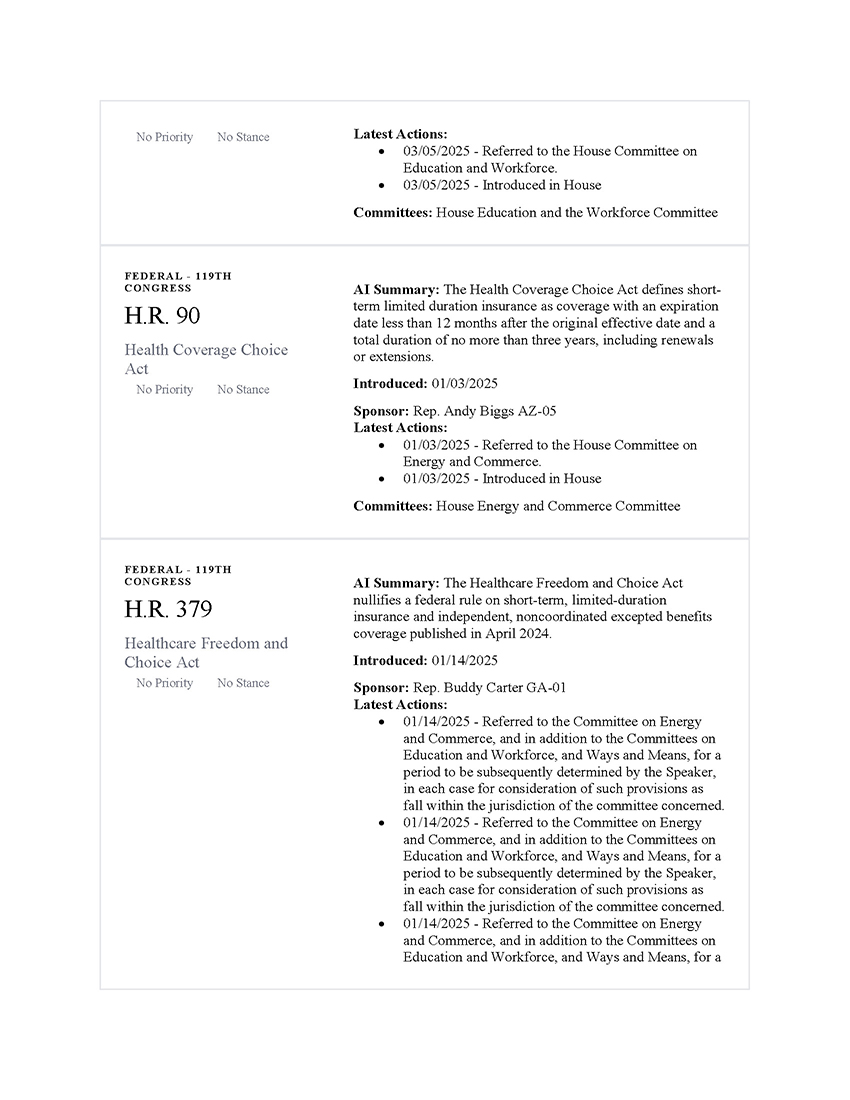
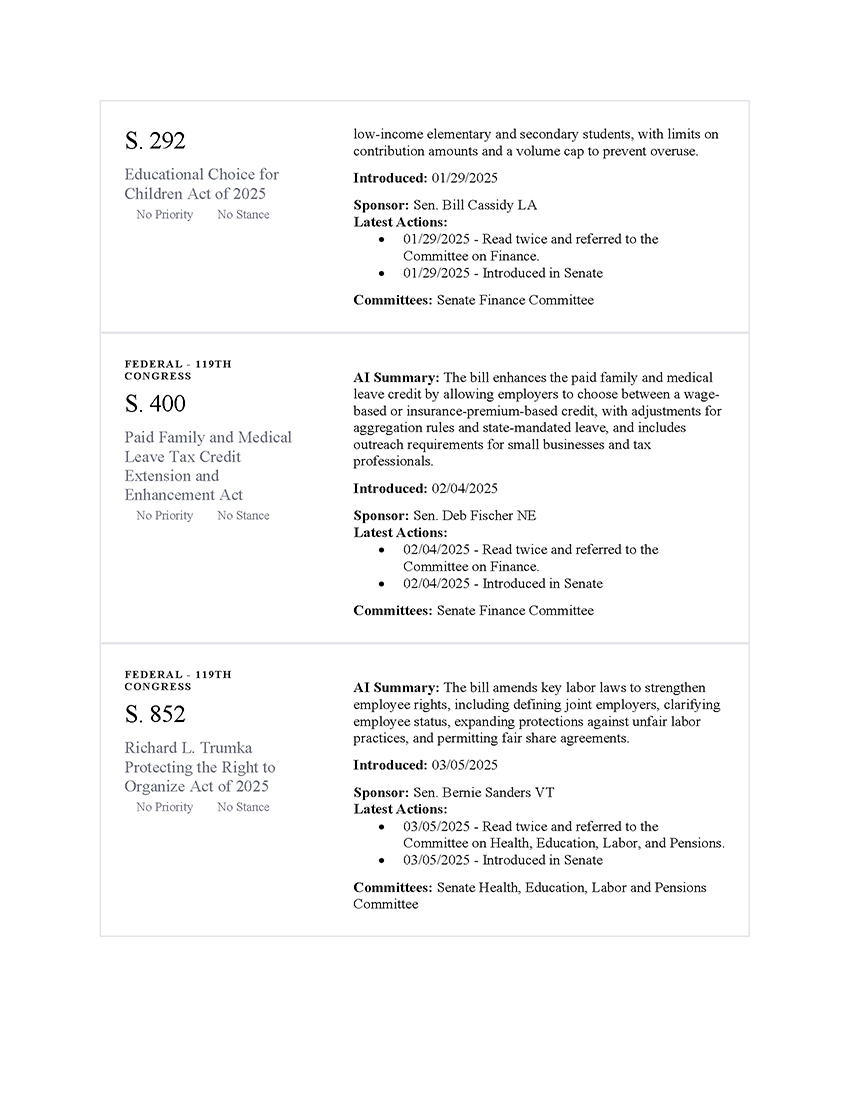
This month, Lobbyit met with Senate HELP majority staff member Romney Gripado, the Health Policy Adviser under Sen. Bill Cassidy. Romney noted that the committee has had limited discussion on short-term limited duration insurance (STLDI), and it wasn’t high on the legislative agenda list given recent regulatory action taking the lead. She mentioned that she did not expect STLDI legislation to be included in summer markups, as the committee is focused on more bipartisan bills and Chairman Cassidy’s end-of-tenure priorities. While the proposal is not considered impossible, movement is unlikely before the fall. Romney noted that the issue has not been identified as a high priority by Sen. Cruz’s office, and a renewed legislative effort would require technical assistance from the relevant agencies as well as a Congressional Budget Office score. However, Romney pointed to several pieces of legislation that were slated for markup in the coming months that may interest the NEA. One bill of interest is the Patients Deserve Price Tags Act, which would codify health coverage transparency requirements, build on existing transparency initiatives, and give employers greater access to individual plan data to help design more comprehensive coverage options.
She recommended engaging additional member offices from the Senate HELP committee to gauge interest and emphasized that bipartisan support, including a Democratic cosponsor, would improve the bill’s prospects of making it to the markup slate. We also offered to liaise between her and Sen. Cruz’s staff to discuss moving the COMPETE Act forward.
However, Romney pointed to several pieces of legislation that were slated for markup in the coming months that may interest the NEA. One bill of interest is the Patients Deserve Price Tags Act, which would codify health coverage transparency requirements, build on existing transparency initiatives, and give employers greater access to individual plan data to help design more comprehensive coverage options.
Work on the Hill
The month of June ended with House Republican leaders facing another major setback as internal divisions within the conference stalled the legislative agenda and forced the House to begin its July 4th recess two days early. For the second consecutive week, Speaker Mike Johnson was unable to move key legislation through the House after a group of Republican members blocked a procedural rule tied to the annual National Defense Authorization Act (NDAA) and a FY2027 spending package. The failed vote halted consideration of the defense policy bill, national security-related appropriations legislation, and other measures that leadership had hoped to advance before the holiday recess.
At the center of the dispute was the SAVE America Act, a Republican-backed election bill that would impose new federal voter identification and citizenship proof requirements. A bloc of conservatives, led in part by Rep. Anna Paulina Luna (R-FL), pushed to attach the SAVE America Act to the NDAA. Although Speaker Johnson explored procedural options to satisfy those demands, the proposal still failed to unite the conference. The episode underscored the difficulty Johnson faces in managing a narrow Republican majority, where even a small group of members can derail floor action.
The breakdown was not limited to the SAVE America Act. Other Republican members raised separate concerns, including demands for border security legislation and objections over the handling of an amendment related to pension funding. These overlapping grievances created a broader leadership problem within the legislative agenda: members of the Republican caucus were not simply objecting to one bill, but using the rule vote to express frustration over multiple unresolved priorities. As a result, House leadership left DC with unfinished work on defense policy, appropriations, border security, and other must-pass or high-priority items.
The timing is especially significant because the House has limited floor time remaining before it enters the August recess. Although House appropriators have reported all twelve FY2027 funding bills out of committee, moving those bills across the House floor remains much more difficult given the conference’s repeated rule defeats and the broader disagreement over spending, defense, border policy, and prioritization of other legislation.
June also included one of the few major bipartisan legislative developments of the year with the passage of the 21st Century ROAD to Housing Act. The Senate passed the package with overwhelming bipartisan support, and the House followed with a 358–32 vote. The bill is aimed at addressing housing affordability and supply, including provisions related to construction, housing finance, manufactured housing, institutional investor activity, and disaster recovery. However, the housing bill has become entangled in the broader fight over the SAVE America Act after President Trump canceled a planned signing event and said he would not act on the housing legislation until Congress advanced the election bill. Speaker Johnson later indicated that the housing bill would still be sent to the White House, meaning it could become law with the president’s signature or, if not vetoed, after the constitutional review period expires.
On immigration and border policy, Congress did complete one major Republican priority earlier in June. The House passed a roughly $70 billion immigration enforcement package to fund ICE and Border Patrol, following Senate action through the reconciliation process. The vote was narrow and largely party-line, reflecting continued partisan division over immigration enforcement, border funding, and oversight of the administration’s immigration agenda.
Defense and national security spending also remained a major focus. The Trump administration submitted an $87.6 billion supplemental funding request to Congress in late June, including approximately $67.15 billion for military operations and related defense needs. That request added another layer of complexity to the already crowded congressional agenda, particularly as Republicans have debated whether another reconciliation package could realistically move through the House given the conference’s repeated internal disputes.
The Supreme Court also closed out its term in late June with a series of rulings carrying significant implications for the administration’s agenda. In Trump v. Cook, the Court ruled 5-4 that the president lacked authority to remove a sitting Federal Reserve governor absent cause, preserving the Fed’s traditional independence from direct presidential control, though the narrow margin suggests the question of executive authority over independent agencies remains contested within the Court. That question was resolved differently in Trump v. Slaughter, where the Court overturned the nearly ninety-year-old precedent set in Humphrey’s Executor v. United States and eliminated for-cause removal protections for commissioners at the Federal Trade Commission. The decision substantially expands presidential authority over independent regulatory agencies and is expected to have ripple effects across other multimember commissions structured similarly to the FTC, including potentially the NLRB, FCC, and SEC, raising questions for industries that rely on the predictability of independent agency rulemaking. The court also ruled on cases related to immigration, transgender athletes, and birthright citizenship in a major month for the judiciary.
All in all, June saw a Congress increasingly unable to convert unified Republican government into a functioning legislative agenda, even as SCOTUS delivered a term that reshaped executive power, immigration, and civil rights law in ways that will outlast this month’s headlines. House leadership enters July with all twelve FY2027 appropriations bills reported out of committee but no clear path to the floor, an unresolved standoff over the SAVE America Act, an $87.6 billion defense supplemental still pending, and a Senate lagging behind in its release of appropriations and other major legislative packages. The next few months will see renewed pressure on government funding deadlines, continued negotiation over whether election legislation can be decoupled from other priorities, and further fallout from the Court’s Slaughter and Cook decisions as the White House tests the new boundaries of presidential removal power.
CMS proposed rule on STLDI pending OIRA review
CMS has moved forward on rulemaking to redefine short-term, limited-duration insurance, with the proposed rule now listed on the federal regulatory agenda as an economically significant action, meaning it’s expected to have a substantial impact on the market. This follows the tri-agency statement from last August in which HHS, Labor, and Treasury signaled they would revisit the Biden administration’s 2024 STLDI rule, which had tightened the definition to a three month initial term and four month total duration. In the interim, the departments told states they would not face enforcement penalties for applying their own, more permissive definitions of STLDI while the federal rulemaking process plays out.
As of early June, the proposed rule is under review at the Office of Information and Regulatory Affairs. The listing does not yet include the in-depth explanation of the proposed changes, but given the administration’s stated goal of expanding access to lower cost coverage options, it’s widely expected to move back toward the more generous terms set under the first Trump administration, which allowed initial terms of up to 12 months and renewals extending total coverage to 36 months. However, topline summaries included in the rule indicate that it would “amend the definition of short-term, limited-duration insurance (STLDI) for purposes of exclusion from the definition of individual health insurance coverage under section 2791(b)(5) of the Public Health Service Act.” A proposed rule is expected around August, at which point the specific duration limits, renewal terms, and disclosure requirements will become clear and the comment period will open. We will continue monitoring both legislative and regulatory moves that relate to STLDI, particularly as this proposed rule advances, and identify opportunities for advocacy including comment windows and re-engaging with our contacts at CMS.
CMS issues final rule on Medicaid work requirements
The Trump administration is easing the rollout timeline for new Medicaid work requirements, giving states a longer runway to sort out who qualifies for exemptions. On Monday, the Centers for Medicare and Medicaid Services issued an interim final rule spelling out how states should handle the exemption process tied to work requirements created under the 2025 One Big Beautiful Bill Act. Under the new guidance, beneficiaries can simply self-declare that they qualify for an exemption in 2027, with actual documentation not required until 2028.
The work requirements apply to the 40 states plus Washington, D.C. that expanded Medicaid under the Affordable Care Act, and they’re set to take effect next year. Adults between 19 and 64 in the expansion population will need to log 80 hours a month of work, job training, school, or volunteering to keep their coverage. There are carve-outs built in, covering pregnant women, parents of kids under 14, and people considered medically frail, a category CMS defines as having a medical condition serious enough to limit someone’s ability to meet the requirement. States also have room to grant other temporary exemptions, such as for people in inpatient care.
CMS Administrator Mehmet Oz framed the phased approach as striking a balance, saying officials want to be forgiving without being naive about fraud. That messaging echoes pushback from conservative groups like the Paragon Health Institute, which had urged CMS to skip self-declaration altogether, arguing it opened the door to the kind of fraudulent sign-ups that plagued ACA exchanges. Paragon ultimately called Monday’s rule a reasonable compromise between program integrity and support for people who genuinely need it.
So far, only Nebraska has actually implemented the requirements, starting in May, with Montana and Arkansas expected to follow in July. States say the transition is expensive, with some reporting they’re spending tens of millions of dollars on staffing and technology upgrades ahead of a January 1 deadline. The federal government allocated $200 million to help states modernize their systems and arranged discounted vendor deals to ease the cost.
Critics remain skeptical of the whole framework. Advocacy groups warn that eligible people could still lose coverage simply due to paperwork confusion, and the Congressional Budget Office has projected 5.3 million people could lose coverage by 2034. Data from KFF also shows most Medicaid expansion enrollees already work, either full or part time, with others sidelined by caregiving duties or illness. Republicans backing the policy argue it will help move able-bodied adults toward employer coverage, freeing up Medicaid resources for the most vulnerable.
DOJ releases memo deeming EEOC disparate impact guidance unconstitutional
The Justice Department has declared that the Equal Employment Opportunity Commission’s longstanding guidance on unintentional workplace discrimination is unconstitutional, giving the agency legal cover to abandon decades of enforcement policy. In an opinion memo released June 9th, DOJ’s Office of Legal Counsel argued that EEOC’s use of the disparate impact theory actually pressured employers into racial discrimination rather than preventing it, by evaluating hiring practices based purely on outcomes rather than intent.
Acting Attorney General Todd Blanche framed the decision as correcting a contradiction at the heart of civil rights enforcement, arguing that EEOC’s interpretation of disparate impact liability under Title VII undermined the very equality it was meant to protect. He said the new opinion frees businesses to hire based on performance without fear of running afoul of the law, describing it as a restoration of equal opportunity in the workplace.
The timing lines up with EEOC’s own announcement last week that it plans to stop applying disparate impact theory in its investigations to the fullest extent it legally can. That move fits into the broader pattern of the Trump administration rolling back diversity, equity, and inclusion policies across the federal government.
This shift represents a significant departure from how civil rights law has been applied in employment contexts for years. Disparate impact theory has historically served as a tool for identifying discrimination that isn’t overt or intentional, such as a hiring test or physical requirement that disproportionately screens out applicants of a certain race or sex even if that wasn’t the employer’s goal. Critics of the DOJ opinion are likely to argue that scrapping this framework removes a key mechanism for catching subtler forms of workplace bias, while supporters see it as ending an approach that unfairly penalized businesses for outcomes they didn’t intend and couldn’t easily control. The practical effect going forward will depend heavily on how EEOC translates this legal opinion into actual changes to its investigative and enforcement procedures.
EEOC rescinds affirmative action guidance
The Equal Employment Opportunity Commission has taken another step in its ongoing rollback of civil rights era enforcement tools, this time targeting affirmative action guidance that has been on the books for more than four decades. On June 29th, the Republican-controlled EEOC voted to strike guidelines under section 607 of the Civil Rights Act of 1964, with the agency arguing in a press release that they contradict Title VII and run afoul of Supreme Court precedent.
The guidelines in question date back to 1979 and laid out a three step process for employers looking to implement affirmative action programs. They defined affirmative action narrowly, as actions appropriate for overcoming the effects of past or present practices, policies, or other barriers to equal employment opportunity, and were meant to be used only in limited circumstances.
The vote was not unanimous. Kalpana Kotagal, the commission’s sole Democratic member, voted against the rescission and wrote later that the move strips employers of a valuable tool for combating workplace discrimination. She pushed back directly on the idea that the guidelines had caused any harm, noting there is no evidence they’ve been abused, and argued that despite the administration’s framing around even handed enforcement, the rescission amounts to another attack on civil rights protections for workers.
This latest move fits a broader pattern under Chair Andrea Lucas, who has been an outspoken critic of diversity, equity, and inclusion initiatives since taking over the agency in 2025. Under her leadership, the EEOC has moved to scrutinize DEI programs more aggressively, pulled back from its use of the disparate impact theory in enforcement, recommended eliminating EEO-1 reporting on race and gender, and rescinded Biden era harassment guidance that had been developed in part to protect LGBTQ+ workers. Lucas has also gone further than agency policy alone, sending letters to Fortune 500 companies and major law firms warning them about what she describes as illegal DEI practices.
National Employers Association