

Engagement
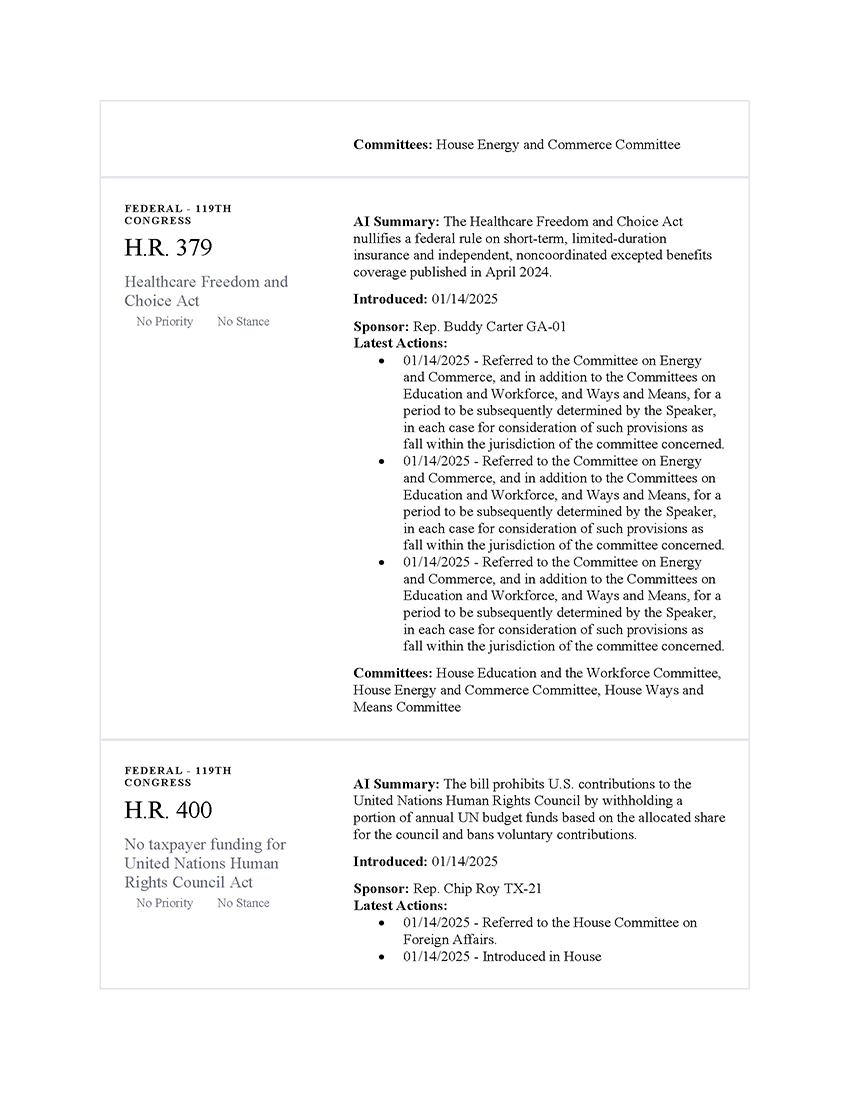
This month, Lobbyit coordinated with OIRA regulatory staff to set up an Executive Order 12866 meeting regarding the proposed rulemaking for Short-Term Limited-Duration Insurance (STLDI) coming out of CMS. The meeting, originally scheduled for August 5th, has been pushed to August 13th at the request of CMS staff.
Work on the Hill
In the final week before the August recess, Congress saw a packed legislative agenda. House Republicans were successful in pushing through a stopgap funding bill, a third reconciliation package, and the NDAA in rapid succession. All of these are involved in the same underlying fight: the SAVE America Act, which would require proof of citizenship to register to vote in federal elections and mandate ID to cast a ballot. The election integrity bill has repeatedly failed to gain a Senate majority on its own, leading House Republicans to attempt to tack it onto other legislative vehicles in the hopes that it will force Senate action. The House has closed July with real wins, but serious challenges remain in the Senate as August recess quickly approaches.
On July 21st, the House of Representatives voted roughly along party lines (220-205) to extend the existing government funding levels until December 4th, pushing the funding fight past the November midterm elections. The current shutdown deadline, if the continuing resolution doesn’t pass the Senate, would come at the end of September. The political timing is a key factor in this calculus, as Republicans fear that a government shutdown a month before the midterm elections would cost them significantly — and give Democratic negotiators a reason to hold out. Six Democrats joined Republicans to advance the bill, while Democratic leadership objected to the lack of immigration enforcement guardrails that would let the administration continue using Border Patrol and ICE funding without any meaningful reform conditions. Additionally, many Republicans have called to attach the SAVE America Act to the funding bill; Speaker Johnson stated earlier this month that he is open to attaching it “to everything that makes sense” — but doing so would likely ruin the bill’s chances of survival in the Senate. Senate Majority Leader John Thune has said that the Senate’s version of this bill will likely look different, requiring more bipartisanship to pass the 60 vote cloture threshold. The Senate Appropriations Committee remains divided over how to split new spending between defense and non-defense priorities, making it increasingly difficult for all 12 annual spending bills to get passed before the fiscal year ends.
On July 22, the House of Representatives voted 216-214 to adopt the framework for a $95 billion reconciliation package. This would include $73 billion for military and intelligence spending, covering costs related to the Iran war and a servicemember pay shortfall the Pentagon says will hit in August. $12 billion will be allocated towards farm assistance, and $10 billion for election-related matters including potential voter-ID grants. This is the third reconciliation bill Republicans have introduced this Congress. Republican leaders are pitching the package as an urgent national security necessity, though it still falls far short of the $350 billion in new Pentagon funding that President Trump had originally wanted. They have also added pieces of the SAVE America Act to this reconciliation bill; Speaker Johnson called this the “best shot” to enact as much of the Act into law as possible. However, similarly to the continuing resolution, this plan faces many challenges in the Senate, where it has failed to gain a simple majority for months.
Ultimately, the House of Representatives advanced the National Defense Authorization Act (NDAA) with a 216-212 vote on July 22, with the SAVE America Act merged into the final text. 7 Republicans voted no, 6 Democrats voted yes. The bill authorizes 5-7% pay raises for military personnel, increases weapons procurement, replenishes depleted stockpiles, and formally renames the Department of Defense as the Department of War. Representatives debated roughly 320 amendments, including proposals to permanently ban transgender military service, block Tricare funding for gender-affirming care, study cutting the civilian defense workforce by 200,000 positions, and bar Pentagon funding from arming Ukraine. Most Democratic amendments were rejected, including attempts to cut the bill’s topline below $1 trillion and to end funding for the Iran war. Additionally, Trump has said he won’t sign any other pending legislation until the SAVE America Act reaches his desk, which greatly raises the stakes on how this bill is handled in the Senate. However, there is still a difficult path ahead. The Senate version of this bill was blocked by Democrats, in strong opposition to both the voting security text and the underlying context of the war in Iran. Senate Minority Leader Chuck Schumer has said that “the NDAA cannot become a permission slip for that recklessness that we see occurring in Iran.”
The House has now departed Washington for a five-week August recess. The Senate is currently scheduled to remain in session through August 7th, though some Senators have called for the recess to wait until urgent business (including the SAVE Act) is addressed. Looming ever closer are the November midterms, as primaries continue and pressure is placed on the House and Senate members up for reelection. Two July congressional generic-ballot surveys showed Democrats leading Republicans by 7 and 11 percent respectively. Republicans also face broader political challenges, including gasoline prices exceeding $4 per gallon, continued public dissatisfaction with the war in Iran, elevated inflation and interest rates, and declining approval ratings for President Trump. The administration’s announcement of another tariff regime may further elevate economic concerns. Although the national unemployment rate remains low, younger workers continue to report difficulty finding employment. Recent polling also indicates that voters currently place greater trust in Democrats on several major issues, including the economy and immigration. As we look to the remainder of this year, the legislative agenda will be filled with major bill packages, funding and reauthorization deadlines, and attempts to win votes before the country heads to the polls.
CMS Medicaid Work Requirements
Continuing this month, the Centers for Medicare & Medicaid Services reviewed comments on an interim final rule with comment period, “Medicaid Program: Community Engagement Requirement for Certain Individuals,” implementing the work requirement provisions included in last year’s budget reconciliation law (H.R. 1). The rule requires certain Medicaid applicants and enrollees aged 19 through 64 to meet an 80 hour per month work requirement through employment, education, work programs, or community service, as a condition of eligibility. The requirement applies to all 41 states that expanded Medicaid under the Affordable Care Act, including DC.
The public comment window closed July 31st, and because CMS issued the policy as an interim final rule rather than through standard notice and comment rulemaking, the provisions became effective on that same date, July 31st, even as comments were still being accepted. The rule therefore took legal effect without CMS needing to issue any further final rule, despite the comment period technically remaining open through the same date.
States must implement work requirements by January 1, 2027, though some may move sooner through 1115 waivers. A few states have already gotten ahead of the deadline: Nebraska started in May, Montana began in July, and Iowa is set to start in December.
For employers, the practical significance lies in the exemption criteria and verification procedures still being finalized. The comment period gave stakeholders a chance to weigh in on issues like the medical frailty definition, verification procedures, and exemption criteria, all of which affect how administrable the rule will be for states and how much churn employers may see among Medicaid-dependent workers. Litigation from several states challenging the rule is also underway, adding further uncertainty to the implementation timeline.
House Committee Advances Health Care Price Transparency Bill
The House Energy and Commerce Committee unanimously approved H.R. 9393, a bipartisan price transparency bill, on July 21, 2026. Chair Brett Guthrie (R-Ky.) described it as the capstone of the committee’s yearlong push on health care affordability, and it was cosponsored with ranking member Frank Pallone (D-N.J.). It is the first major transparency bill of its kind to clear committee this year, as multiple House and Senate panels have taken up similar measures amid a broader bipartisan focus on affordability.
At its core, the bill requires hospitals and insurers to disclose more detailed price information and claims data to both patients and employers who administer benefits plans, with the stated aim of making costs less opaque and letting patients shop for lower-cost care. Those transparency requirements would extend beyond hospitals and insurers to cover lab tests, imaging centers, and outpatient surgical centers as well.
The bill also incorporates provisions from other committee members targeting Medicare Advantage plans, requiring insurers to disclose more data on cost-sharing, supplemental benefits spending, and premium revenue, aimed at improving oversight of privately run plans.
Providers won a significant concession in the bill’s prior authorization provisions, which would require insurers to automate the approval process and publicly disclose denial rates, a response to longstanding complaints from doctors and hospitals about treatment delays and administrative burden.
The legislation also folds in funding priorities for Health Secretary Robert F. Kennedy Jr., authorizing $500 million for behavioral and mental health services and $250 million for nutrition health services at federally qualified health centers, spread over two years.
Separately, the committee approved a related but distinct measure from Rep. Mariannette Miller-Meeks (R-Iowa) that would require hospitals to physically post their prices in public areas. That bill passed despite opposition from Democrats on the panel, unlike the broader transparency package, which drew unanimous support.
EEOC Proposes Ending Annual Workforce Demographic Data Collection
The Equal Employment Opportunity Commission (EEOC) has released a proposal that would rescind requirements for employers to file annual reports on workforce demographic data.
Under current EEOC regulations, private businesses with at least 100 employees must submit annual data on their staff’s race and gender. Federal civil rights law separately requires private employers to compile and maintain hiring-related fairness records.
EEOC Chair Andrea Lucas, a Trump appointee, argues the annual reporting requirement imposes an undue regulatory burden and could undermine the agency’s core mission. During a public meeting on July 21st, Lucas said the process “may encourage employers to engage in discrimination to avoid potential EEOC enforcement actions to address perceived quote-unquote ‘inequitable’ outcomes.”
Kalpana Kotagal, the lone Democratic commissioner, pushed back, arguing that eliminating the demographic data collection will hamper the agency’s ability to spot discrimination patterns before opening full investigations. She called the approach “see no evil, hear no evil,” adding that discrimination “doesn’t go away just because you erase the data. It just becomes harder to prove.”
The commission voted 2-1 along party lines to move forward with the proposed rule. The move is the latest in a broader pattern of the Trump administration targeting diversity, equity, and inclusion efforts across federal civil rights offices, with officials arguing that some affirmative action policies themselves amount to discrimination.
For NEA members, the practical implication is a potential end to the yearly compliance burden of compiling and submitting workforce race and gender data, though the outcome depends on how the rulemaking process unfolds and whether the shorter 30-day comment window draws significant pushback before finalization.
House E+W Committee Advances Bill to Classify Temp Health Care Workers as Independent Contractors
The House Education and Workforce Committee voted along party lines, 18-15, on July 21st, to advance H.R. 8347, sponsored by Rep. Burgess Owens (R-Utah), which would classify temporary health care workers, known as locum tenens providers, as independent contractors and exempt them from Fair Labor Standards Act protections.
Locum tenens workers, including doctors, nurses, and other clinicians temporarily assigned to fill staffing gaps, are widely used by health providers in rural and underserved areas facing growing workforce shortages. Owens described the bill as “pro-worker, pro-patient,” arguing that independent contractor status gives these workers more flexibility to quickly step into or leave staffing roles as needed.
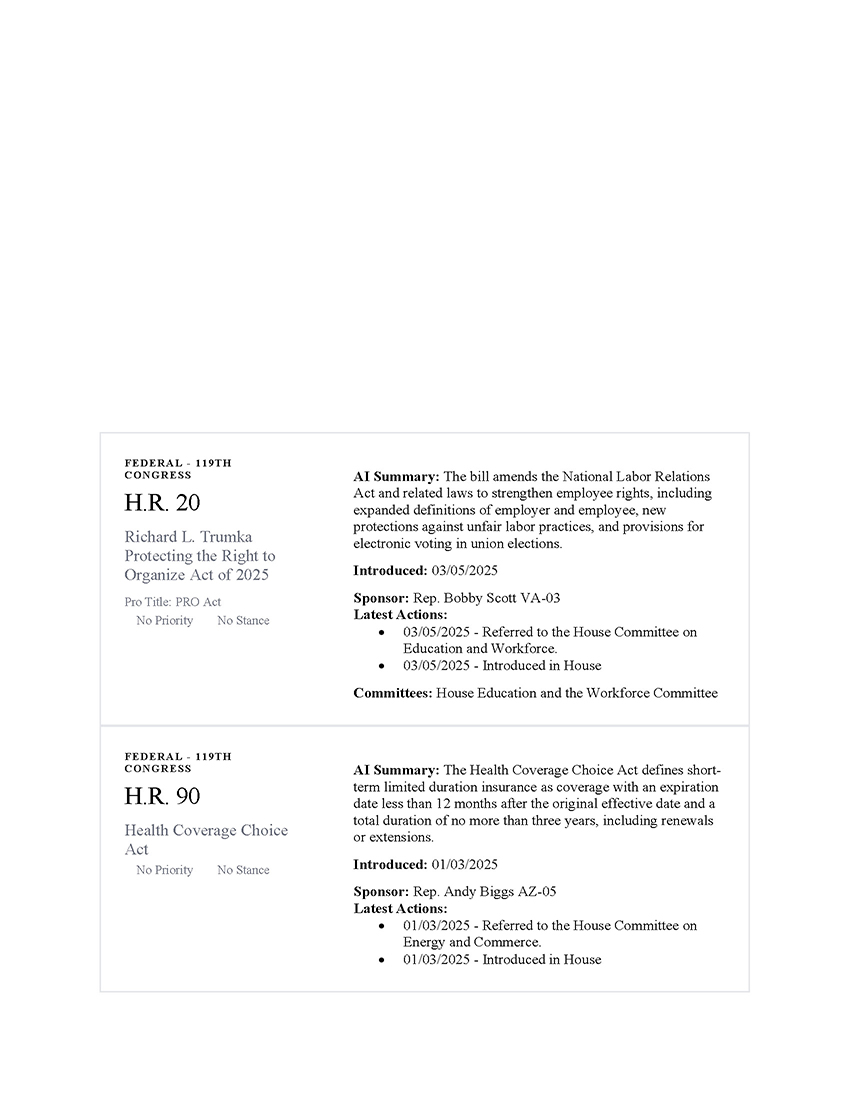
Committee Democrats unanimously opposed the measure. Ranking member Bobby Scott (D-Va.) warned it would let large health care conglomerates convert some of the highest-paying clinical jobs into permanent temporary positions without benefits or labor protections, saying it would allow companies “to reduce some of the highest paying jobs into perma-temps.” Democrats broadly argued the bill would weaken labor protections and let hospitals rely indefinitely on contracted workers without the obligations that come with employee status.
The bill now heads to the full House, though it’s unclear how it will fare there. Its committee passage could position it for inclusion in a broader health care package later this year.
National Employers Association