

Engagement
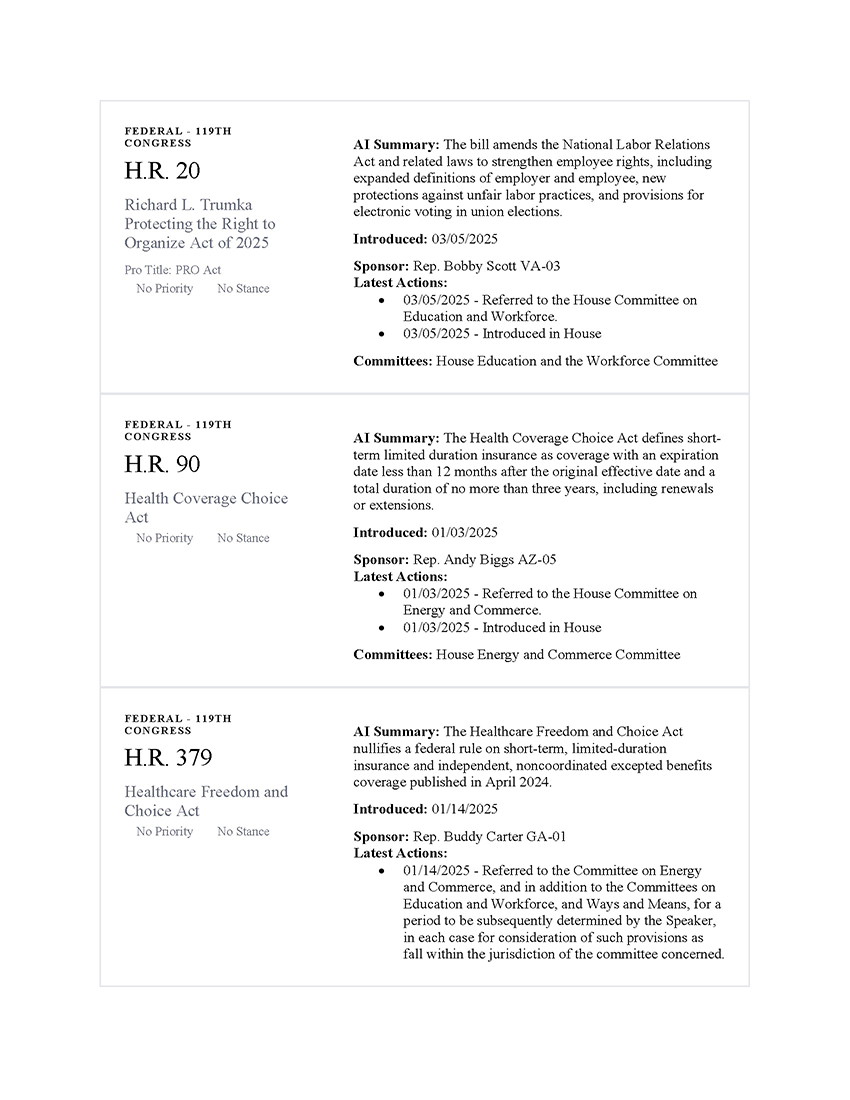
On October 13th, Lobbyit met with Conner Morrill and Ryan Orr in the office of Sen. Ron Johnson (R-WI) to discuss his work on STLDI policy and the outlook for healthcare flexibility heading into the 120th Congress. We thanked the office for the Senator’s longstanding leadership on the issue, including S. 2641 last Congress and the letter he led in 2017 urging CMS to act on STLDIs. We walked through NEA’s priority of restoring the 2018 rule allowing plans of up to 36 months, rather than the 4-month cap set under the Biden administration, and noted that while CMS announced non-enforcement of the Biden rule last year, it has not formally rescinded it. We explained that roughly a dozen states would offer STLDI coverage with clearer rulemaking in place, but are holding back out of concern that non-enforcement could be reversed quickly.
Conner agreed that formal rulemaking from the administration would be the ideal fix. He noted that the implementation timeline discussed coming out of the legal challenges to the Biden rule pointed to summer 2026, which has now passed. If the administration does not propose a new rule, he expects the Senator would want to reintroduce S. 2641 next Congress. On the idea of a new letter to CMS, Conner said the office had floated it when S. 2641 was introduced but has not revisited it since. He and Ryan seemed open and said they will check in with the Senator, adding that the office would reach out to us if they need help with cosponsors or letter drafting.
Work on the Hill
Congress spent October away from Washington as lawmakers campaigned ahead of the November 3rd midterms. With floor activity on hold, attention has shifted to the crowded agenda waiting after Election Day. Control of the House and Senate will shape the rest of President Trump’s term, including spending, oversight and regulatory policy.
Appropriations remain the top concern for the lame duck window. The House has passed three of the twelve Fiscal Year 2027 appropriations bills, while the Senate had yet to complete any floor action before the pre-election recess, leaving Congress to choose between an omnibus, another continuing resolution or a hybrid before the December 11th deadline. Senators Susan Collins and Patty Murray are leading an effort to add language to the Labor-HHS-Education bill protecting grantmaking from political interference, with similar protections under consideration for environmental research grants. The current CR’s temporary restriction on OMB’s proposed federal grants rule also expires on December 11th, making it part of the negotiations.
Healthcare deadlines are close behind. Community Health Center Fund mandatory funding expires December 31rd, along with the temporary 2.5% Medicare physician payment increase. Both will likely ride on a year-end funding package.
Permitting reform is another major post-election priority. Senators Mike Lee, Martin Heinrich, Shelley Moore Capito and Sheldon Whitehouse negotiated the Bipartisan American Affordability and Jobs Act, which would speed environmental reviews and transmission development while easing obstacles to pipeline construction. It also requires data centers to cover the transmission costs tied to their electricity demand rather than passing them to other ratepayers. Industry groups including the American Petroleum Institute and American Clean Power Association coordinated support in October, but disputes over environmental protections, tribal interests and offshore wind permits remain ahead of a procedural vote after the elections.
Energy costs became a bigger issue this month. Retail diesel averaged about $6.28 a gallon on October 19th, more than $2.65 above a year earlier. Following bipartisan pressure from senators, the administration moved to loan nearly a third of the emergency heating oil reserve, and Northeast Democrats are pushing for emergency LIHEAP funding that could surface in appropriations talks. With the Strait of Hormuz still blocked and high prices still hovering at the pump, energy affordability has remained a key component of both parties’ midterm platform.
The month’s biggest flashpoint in Washington came on October 16th, when President Trump signed an executive order waiving key provisions of the Lindsey O. Graham Sanctioning Russia and Iran Act two days before they were set to take effect, citing national interests. The waiver drew criticism from members of both parties, but with Congress in recess until after the midterms, there were limited opportunities to respond right away. The legislative branch will look to respond when they return from their recess in the coming weeks.
Several other must-pass bills are also lined up for the lame duck. On the Farm Bill, the House passed the Farm, Food, and National Security Act of 2026 on April 30th by a 224-200 vote, and the Senate Agriculture Committee reported its own version in September, with SNAP state cost-sharing still the main sticking point. The House passed its bipartisan WRDA bill (H.R. 9497) by a 415-9 vote on September 16th, which puts water infrastructure in good shape for year-end. The NDAA has passed the House, but in the Senate it has not reached the floor. Surface transportation programs are also temporarily extended through December 11th, and another short-term extension into 2027 looks likely given the lack of Senate text.
The midterm results will set the tone for everything that comes next. If Republicans hold both chambers, leadership will have a strong incentive to wrap up appropriations and other major bills before the end of the year and carry the President’s agenda into 2027. If Democrats win the House, the Senate or both, we expect a shift in the new year toward oversight and investigations, along with tougher negotiations over spending, healthcare and administration priorities, and some year-end items may be pushed into the next Congress. Either way, the lame-duck session will be a key window, and we are gearing up for a fast-paced end of the calendar year.
DOL Finalizes PBM Fee-Disclosure Rule for Self-Insured Plans
Among the most significant developments in October was the Department of Labor’s final rule requiring pharmacy benefit managers to disclose their fees and compensation to the fiduciaries of self-insured group health plans. Announced on October 29th by the Employee Benefits Security Administration, the rule implements transparency provisions enacted in the 2026 Consolidated Appropriations Act, and follows the proposed rule issued earlier this year. It applies to large self-insured plans — generally those with 100 or more participants or sponsored by employers with at least 100 employees — and to PBMs and their affiliated brokers and consultants that expect at least $1,000 in compensation. The rule takes effect in late December, with its requirements applying to plan years beginning on or after July 1, 2027.
Substantively, covered providers must furnish written disclosures of their services and expected compensation before a contract is entered into or renewed, and then report compensation actually received on a semiannual basis, or quarterly at the plan’s request. Those reports must break out direct compensation from the plan and indirect compensation, including manufacturer rebates, spread pricing, pharmacy recoupments, and price-protection payments. Plans also gain the right to audit PBM disclosures, choose their own auditor, and access pharmacy and manufacturer contracts — and PBMs may not restrict those audits beyond reasonable confidentiality terms. The Department estimates the rule could save employers and employees up to $22 billion over the next decade.
For years, plan sponsors have struggled to see how much their PBM earns from rebates and spread pricing; this rule puts that information in front of them on a regular schedule and gives them the tools to verify it. That transparency also carries responsibility. Under ERISA, the disclosures exist so fiduciaries can judge whether compensation is reasonable — meaning employers will be expected to review what they receive and act on it. The rule includes an exemption that protects fiduciaries when a PBM fails to disclose, but only if the employer notifies the Department, seeks correction, and documents its decision to continue or end the arrangement.
CMS Proposes Ending Automatic Re-Enrollment for Subsidized Marketplace Enrollees
On October 23, CMS proposed a rule that would require consumers on the ACA exchanges to verify key eligibility information — including household income and citizenship status — before receiving premium tax credits, both at initial enrollment and at each annual renewal. The proposal implements a policy mandated by the One Big Beautiful Bill Act and, if finalized, would take effect for the 2028 coverage year. The practical consequence is the end of automatic re-enrollment for subsidized enrollees: individuals who take the tax credit in advance, as well as those who claim it when filing their tax returns, would need to verify their information with CMS before the credit is approved and again at every renewal. Only enrollees who receive no subsidy — generally those earning more than 400% of the federal poverty level, roughly $60,000 for an individual — could continue to be re-enrolled automatically.
The proposal comes amid heightened scrutiny of marketplace fraud by both CMS and congressional Republicans, who have focused on “phantom enrollees” — individuals signed up for coverage without their knowledge by brokers seeking additional commissions. CMS recently removed roughly 760,000 people from ACA coverage on that basis, and fraud was a central argument Republicans made last year in opposing an extension of the enhanced premium tax credits. The rule would add a meaningful administrative step for the large majority of exchange enrollees who receive a subsidy, and coming on top of the expired enhanced credits and projected 15% premium increases for 2027, it is likely to further reduce marketplace enrollment — particularly among younger and healthier consumers who are least likely to complete renewal paperwork.
A smaller and potentially sicker individual-market risk pool would put further upward pressure on premiums, which raises the cost of individual coverage HRA strategies and reinforces the relative value of traditional employer-sponsored coverage. Employers may also see more employees, spouses, and dependents moving onto group plans as marketplace coverage becomes harder to keep. On the compliance side, because the ACA’s employer shared-responsibility penalties are triggered when a full-time employee receives a premium tax credit, stricter up-front verification could reduce erroneous credit determinations that lead to penalty assessments — a potential benefit for employers that already offer affordable coverage. Lobbyit will track the comment period and the rule’s progress toward finalization, and flag for NEA any opportunity to weigh in on how employer-coverage information is verified.
Looking Ahead: No Surprises Act Reform Could Move in the Lame Duck
One issue with a real chance of moving before the 119th Congress adjourns is a rewrite of the No Surprises Act, the 2020 law that shields patients from surprise out-of-network bills after emergency care. The law’s independent dispute resolution (IDR) process, in which an arbitrator chooses between the provider’s and the plan’s payment offers, has been flooded far beyond what Congress anticipated — 2.5 million claims last year, up from 1.5 million the year before — with arbitrators in some cases awarding payments well above the cost of care. A CMS rule finalized in May to streamline the process, including a five-day eligibility determination for claims, has not quieted calls for legislation. Rep. Greg Murphy (R-N.C.) said in mid-October that he expects the Ways and Means Committee to have a plan during the lame duck, which will run two weeks before Thanksgiving and roughly three weeks in December.
The competing proposals point in sharply different directions for employers. Murphy’s No Surprises Act Enforcement Act (H.R. 4710), with 38 bipartisan cosponsors and a Senate companion from Sens. Roger Marshall (R-Kan.) and Michael Bennet (D-Colo.), would impose $10,000 penalties per violation on group health plans and insurers that fail to comply with the law’s balance-billing requirements, and a penalty of three times the disputed amount, plus interest, on parties that fail to pay arbitration awards. It is backed by the American Medical Association and a coalition of 96 physician groups. Employers have lined up against it: nearly 60 major employers, including Delta Air Lines, Microsoft, and Dow, wrote to Ways and Means in July arguing that new penalties layered on a flawed IDR process that rewards ineligible claims “will result in more abuse of an increasingly broken system.” The AFL-CIO has also opposed the Senate bill over its premium impact. At the other end, House Energy and Commerce ranking member Frank Pallone (D-N.J.) introduced the Lower Premiums, Faster Payments Act on October 9th, which would eliminate arbitration, pay providers at median in-network rates within 30 days, and impose no new plan penalties — an approach employers and insurers support and physicians oppose.
For NEA members, the outcome could flow directly into plan costs. A reform focused on screening out ineligible claims and fixing the IDR process would ease a growing cost driver, while an enforcement-first approach like H.R. 4710 would add new penalty exposure for plans without addressing the volume problem. Senate HELP Chair Bill Cassidy, who wrote the original law with Sen. Maggie Hassan and is leaving Congress at year’s end, hopes to introduce a fix before he departs, and the election results will shape which approach has momentum — Pallone would likely chair Energy and Commerce under a Democratic House. This remains worth watching after the election as the lame duck agenda is determined.
National Employers Association